Pages

Showing posts with label Belarus. Show all posts

Struve Geodetic Arc Belarus

The Struve Arc is a chain of survey triangulations stretching from Hammerfest in Norway to the Black Sea, through 10 countries and over 2,820 km. These are points of a survey, carried out between 1816 and 1855 by the astronomer Friedrich Georg Wilhelm Struve, which represented the first accurate measuring of a long segment of a meridian. This helped to establish the exact size and shape of the planet and marked an important step in the development of earth sciences and topographic mapping. It is an extraordinary example of scientific collaboration among scientists from different countries, and of collaboration between monarchs for a scientific cause. The original arc consisted of 258 main triangles with 265 main station points. The listed site includes 34 of the original station points, with different markings, i.e. a drilled hole in rock, iron cross, cairns, or built obelisks.

Struve Geodetic Arc
Continent: Europe
Country: Belarus
Category: Cultural
Criterion: (II) (III) (VI)
Date of Inscription: 2005

Extraordinary example for interchange of human values

The Struve Arc is the first accurate measuring of a long segment of a meridian, helping in the establishment of the exact size and shape of the world exhibits an important step in the development of earth sciences. It is also an extraordinary example for interchange of human values in the form of scientific collaboration among scientists from different countries. It is at the same time an example for collaboration between monarchs of different powers, for a scientific cause.

Struve Geodetic Arc Belarus

Browse Gallery Plus UNESCO Storyline

Outstanding example of Technological Ensemble

The Struve Geodetic Arc is undoubtedly an outstanding example of technological ensemble – presenting the triangulation points of the measuring of the meridian, being the non-movable and non-tangible part of the measuring technology.

The measuring of the arc and its results are directly associated with men wondering about his world, its shape and size. It is linked with Sir Isaac Newton's theory that the world is not an exact sphere.

Slideshow for this Heritage Site


Browse All UNESCO World Heritage Sites in . The original UNESCO inscription Here!!!

Mir Castle Complex Belarus

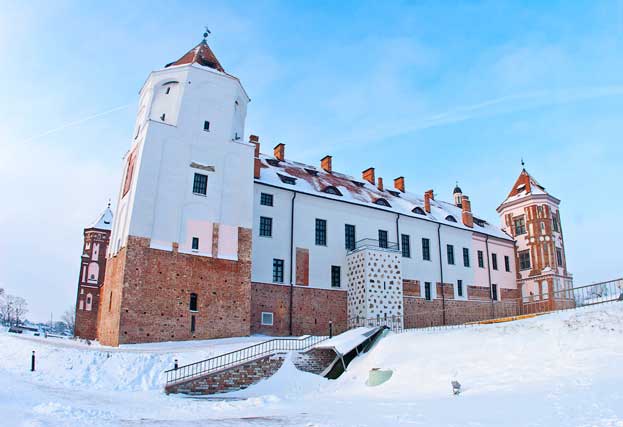
Mir Castle Complex construction of the castle by the Ilyinichi family began at the end of the 15th century, in Gothic style; it was subsequently extended and reconstructed. The initial work consisted of building the walls and towers in Gothic style, but work came to an end for some unknown reason. Building had been completed by the beginning of the 17th century with the addition of palatial accommodation, with some Renaissance features, after it had passed to the Radzivill family. Following sieges in 1655 and 1706 reconstruction work involved the addition of some Baroque features.

Mir Castle Complex Belarus
Continent: Europe
Country: Belarus
Category: Cultural
Criterion: (II)(IV)
Date of Inscription: 2000

Abandoned and restored

The castle complex abandoned for almost a century and suffering severe damage during the Napoleonic period, the castle was restored at the end of the 19th century, with the addition of a number of other elements and the landscaping of the surrounding area as a park. Its present form is graphic testimony to an often turbulent history. The old castle survived as a romantic ruin.

Mir Castle Complex
Mir Castle Complex Belarus

Browse Gallery Plus UNESCO Storyline

The historic monument

Mir Castle is an exceptional example of a central European castle, reflecting in its design and layout successive cultural influences (Gothic, Baroque, and Renaissance) that blend harmoniously to create an impressive monument to the history of this region.

The region in which Mir Castle stands has a long history of political and cultural confrontation and coalescence, which is graphically represented in the form and appearance of the ensemble.

Slideshow for this Heritage Site


Browse All UNESCO World Heritage Sites in . The original UNESCO inscription Here!!!

Belovezhskaya Pushcha Belarus

Belovezhskaya Pushcha is situated on the watershed of the Baltic Sea and the Black Sea, this immense forest range, consisting of evergreens and broad-leaved trees, is home to some remarkable animal life, including rare mammals such as the wolf, the lynx and the otter, as well as some 300 European Bison, a species which has been reintroduced into the park. The Białowieża Primeval Forest is the last remaining primary deciduous and mixed forest of the European lowlands. Located on the watershed of the Baltic and Black seas, this immense forest range consisting of evergreens and broadleaved trees is the home of some remarkable animal life, including rare and interesting mammals. The park comprises about one-tenth of the entire Białowieża Primeval Forest, which has a wide range of flora and fauna typical of both Western and Eastern Europe.

Belovezhskaya Pushcha Belarus
Continent: Europe
Country: Belarus
Category: Natural
Criterion: (VII)
Date of Inscription: 1979

Example of original forests

The park protects a part of the last and one of the largest surviving areas of European primeval lowland mixed forest: pine, beech, oak, alder and spruce. The forest dates back to 8000 BC and is the only remaining example of the original forests, which once covered much of Europe.

These wilderness areas are inhabited by European bison, a species reintroduced into the park in 1929, elk, stag, roe deer, wild boar, lynx, wolf, fox, marten, badger, otter, ermine, beaver and numerous bats. It is also a showplace reserve for tarpan (Polish wild forest horse). The avifauna includes corncrake, white-tailed eagle, white stork, peregrine falcon and eagle owl.

Belovezhskaya Pushcha Poland
National Park Entrance

Browse Gallery Plus UNESCO Storyline

Oldest National Park

Białowieski National Park is the oldest national park in Poland and one of the oldest in Europe. It was founded as 'Reserve' forestry in 1921 but officially established as a National Park in Białowieża in 1932. In 1947 it was restored as the Białowieski National Park. At one time the property of Polish kings, the Białowieski Forests have survived in an almost unaltered form. It is without doubt the most valuable natural area in the European lowlands.

Slideshow for this Heritage Site


Browse All UNESCO World Heritage Sites in . The original UNESCO inscription Here!!!