Pages

Showing posts with label Yemen. Show all posts

#870 Shahara, Yemen

At the top of Jebel Shahara in Northern Yemen, a bumpy military escorted pickup truck ride up an ancient cobble-stoned road, lies an old village with timeless traditions that continue much as they would have millenia ago. Women get water from the central cistern every morning, its green cover a sign of its natural state. The multiple story buildings with icing-like whitewash are the same as they were centuries ago, tall buildings for the age they were built and cozy family-centered communities.

The town itself was a mountain fortress because of its inaccessability, and for centuries has been a safe refuge from invadors (Turkish or domestic) for rural people and Imams alike. It was famous for its scholarship, and the beautiful terraced fields allowed it to be self-sufficient in times of crisis.

The Ancient "Bridge of Sighs" a stone arch above a 300 foot canyon built in the 17th Century to connect two mountain towns is still used to carry grain, sheet, and other local products like the addictive narcotic leaf qat and of course, coffee.

This spectacular place is 2600m above sea level and it is a magnificent journey just to get there. Despite being an important tourist site, there are no restaurants and barely a handful of homestay hotels. The military escort on parts of the road is required by the government due to the likelihood of kidnapping militias, and many cars will not stop en route due to the danger. A really amazing place -- I feel lucky to have been here!

Source: http://www.viewzone.com/y-page31.html

#942 Aden, Yemen

Very few people know that during the Cold War, it wasn't just Korea, Vietnam and Germany were split in half. Another country that fell victim to the power plays of the powers was Yemen. The capital of South Yemen was the city of Aden, an ancient shipping city, with connections to Africa, the Middle East and the Indies because of its strategic location on the Gulf of Aden (across from the Horn of Africa in Somalia). Infamous today for the bombing of the USS Cole in 1992 which occurred in its harbor and was the start of awareness of Yemen's long terrorism connection which continues to this day. Aden, however is a much more interesting city than just that. 

It was a British port in the Colonial era (a convenient stopping off point en route to India), and one particularly interesting hapstance was when a group of Indian-origin migrant workers built a fascinating Zoroastrian temple on the top of the hill above the city. Zoroastrian temples are used to place the bodies of the dead with the intention that the vultures will pick the bones clean so that they can be collected and stored. The temple is no longer functioning as a temple today in conservative Islamic Yemen, but remains a fascinating relic of a bygone era. 

Another really fantastic historical feature of the city are its series of water cisterns that sit at the bottom of the hills that surround the city. These (the Cisterns of Tawila, named for the Wadi Tawila) form the remains of a highly sophisticated water collection system that supplied the city with water from the hills perhaps as far back as 115BC. They were rediscovered and reused in the 19th Century and can still be used today if needed, although water has not filled them for 15 or so years and they are threatened with development and erosion.

In addition to these features, it is a beautiful city, with cream houses creeping up the brown hills, overlooking the clear blue Indian Ocean. It remains a busy shipping lane despite being one of the poorest and forgotten corners of the world. 

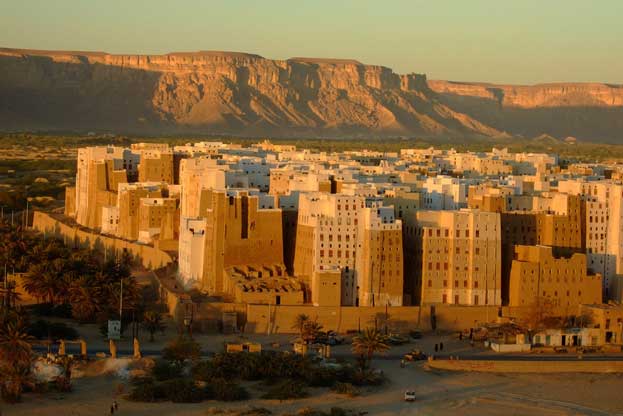
The Old Walled City of Shibam Yemen

The old walled city of Shibam and Wadi Hadramaut constitute an outstanding example of human settlement and land use. The domestic architecture of Shibam is an outstanding characteristic example of houses in the Arab and Muslim world. The rigorous city planning based on the principle of vertical construction is exceptional and an example of a traditional but vulnerable culture. In Shibam there are some mosques, two ancient sultan's palaces, a double monumental door and 500 more buildings, separated or grouped, but all made uniform by the material of which they are constructed: unfired clay.

Old Walled City of Shibam
Continent: Asia
Country: India
Category: Cultural
Criterion: (III)(IV) (V)
Date of Inscription: 1982

Chicago of the desert

Sometimes called the 'Chicago of the desert' or the 'Manhattan of the desert', the old city of Shibam presents to historians and urbanists one of the earliest and most perfect examples of rigorous planning based on the principle of vertical construction.

The Old Walled City of Shibam Yemen

Browse Gallery Plus UNESCO Storyline

The city is built on a hillock, which has allowed it to escape the devastating floods of Wadi Hadramaut and to become the capital of the territory after the destruction of ancient pre-Islamic capital, Shabwa, in AD 300. Its plan is trapezoidal, almost rectangular; and it is enclosed by earthen walls within which a block of dwellings, also built from earth, have been laid out on an orthogonal grid. The highest house is eight storeys high and the average is five.

The impressive structures for the most part date from the 16th century, following a devastating flood of which Shibam was the victim in 1532-33. However, some older houses and large buildings still remain from the first centuries of Islam, such as the Friday Mosque, built in 904, and the castle, built in 1220.

Slideshow for this Heritage Site


Browse All UNESCO World Heritage Sites in . The original UNESCO inscription Here!!!

Socotra Archipelago Yemen

Socotra Archipelago, in the northwest Indian Ocean near the Gulf of Aden, is 250 km long and comprises four islands and two rocky islets which appear as a prolongation of the Horn of Africa. The site is of universal importance because of its biodiversity with rich and distinct flora and fauna: 37% of Socotra's 825 plant species, 90% of its reptile species and 95% of its land snail species do not occur anywhere else in the world. The site also supports globally significant populations of land and sea birds (192 bird species, 44 of which breed on the islands while 85 are regular migrants), including a number of threatened species. The marine life of Socotra is also very diverse, with 253 species of reef-building corals, 730 species of coastal fish and 300 species of crab, lobster and shrimp.

Socotra Archipelago Yemen
Continent: Asia
Country: Yemen
Category: Natural
Criterion: (X)
Date of Inscription: 2008

Heritage Values of Socotra Archipelago

Socotra is globally important for biodiversity conservation because of its exceptionally rich and distinct flora and fauna. 37% of Socotra's plant species, 90% of its reptile species and 95% of its land snail species do not occur anywhere else in the world. Socotra is of particular importance to the Horn of Africa's biodiversity hotspot and, as one of the most biodiversity rich and distinct islands in the world, has been termed the "Galapagos of the Indian Ocean".

World Heritage Socotra Archipelago

Browse Gallery Plus UNESCO Storyline

Socotra is important biodiversity conservation

Biological diversity and threatened species: Socotra is globally important for biodiversity conservation because of its exceptional level of biodiversity and endemism in many terrestrial and marine groups of organisms. Socotra is particularly important for its diversity of plants and has 825 plant species of which 307 (37%) are endemic. Socotra has high importance for bird species as underlined by the identification by Birdlife International of 22 Important Bird Areas on Socotra.

Socotra also supports globally significant populations of other land and sea birds, including a number of threatened species. Extremely high levels of endemism occur in Socotra's reptiles (34 species, 90% endemism) and land snails (96 species, 95% endemism). The marine life of Socotra is also very diverse, with 253 species of reef-building corals, 730 species of coastal fish and 300 species of crab, lobster and shrimp, and well represented in the property's marine areas.

Slideshow for this Heritage Site


The property is of sufficient size to adequately represent all the terrestrial and marine features and processes that are essential for the long term conservation of the archipelago's rich and distinct biodiversity. The terrestrial nature sanctuaries, national parks and areas of special botanical interest included in the property encompass about 75% of the total land area. They protect all the major vegetation types, areas of high floral and faunal values, and important bird areas. The marine nature sanctuaries included in the property encompass the most important elements of marine biodiversity. The property's integrity is further enhanced by terrestrial and marine buffer zones that are not part of the inscribed property.

Protection Requirements

All component areas of the property have legal protection; however there is a need to strengthen the legislative framework, and management and enforcement capacity. Whilst the property's terrestrial and marine habitats are generally still in good condition, management planning needs to deal more effectively with current threats including reading, overgrazing and overharvesting of terrestrial and marine natural resources.

Potential future threats include unsustainable tourism and invasive species. Impacts of these threats on Socotra's biodiversity need to be closely monitored and minimized. A sustainable financing strategy is required to ensure the necessary human and financial resources for the long term management of the property. Appropriate linkages need to be developed between the management of the property, its buffer zones and the Socotra Biosphere Reserve.

Browse All UNESCO World Heritage Sites in . The original UNESCO inscription Here!!!

The Old City of Sana'a Yemen

The old city of Sana'a is an outstanding example of a homogeneous architectural ensemble whose design and detail illustrate an organization of space characteristic of the early centuries of Islam which has been respected over time. The houses of Sana'a, which have become vulnerable as a result of contemporary social changes, are an outstanding example of a unique, traditional human settlement. Countless partial studies have been made of the houses of Sana'a, with the objective of eventual demolition. The beauty of the urban landscape of Sana'a, whose overall appearance should remain intact, attests that they should be preserved integrally.

The Old City of Sana'a
Continent: Asia
Country: Yemen
Category: Cultural
Criterion: (IV)(V) (VI)
Date of Inscription: 1986

Sana'a, the Capital of Yemen

The City of Sana'a, capital of Yemen since 1962, is a fine example of artistic and pictorial quality, now considered to be a homogenous ensemble made up of tower-houses built from rammed earth. Its history covers a period of over 2,000 years. Given official status in the 2nd century BC when it was an outpost of the Yemenite kingdoms, Sana'a (Arabic for 'fortified place') was associated with all the major historical events that took place in Arabia Felix. The site of the cathedral and the martyrium constructed during the period of Abyssinian domination (525-75) bear witness to Christian influence whose apogee coincided with the reign of Justinian.

The Old City of Sana'a Yemen

Browse Gallery Plus UNESCO Storyline

Sana'a during pre-Islamic period

The remains of the pre-Islamic period were largely destroyed as a result of profound changes in the city from 628. Beginning with the early years of the Hegira, Sana'a became a major centre for the spread of the Islamic faith. The Great Mosque is said to have been constructed while the Prophet was still living, with materials recovered from the Ghumdan Palace and the cathedral.

The successive reconstructions of Sana'a under Ottoman domination, beginning in the 16th century, respected the proportions and balance of the medieval city while changing its appearance. At the same time, a new city grew up to the west of the first settlement and is contiguous with it. The new city covers a similar surface area.

The houses in the old city are of relatively recent construction and have a traditional structure. The stone-built ground floor houses provisions and livestock. A staircase leads to the upper floors which normally comprise, successively, a large common room, which served as a meeting room for business affairs; the divan, used exclusively for festivities and family gatherings; smaller, private living quarters; and, last, on the top floor, the mafraj, a room where men meet in the afternoon.

Large windows line three walls of the room forming a kind of loggia. The only differentiating feature of these tower-like houses is the size and number of floors (there may be as many as nine), and the quality of the ornamental and painted decoration of the windows, friezes and coping.

Slideshow for this Heritage Site


Browse All UNESCO World Heritage Sites in . The original UNESCO inscription Here!!!

Historic Town of Zabid Yemen

Zabid's domestic and military architecture and its urban plan make it an outstanding archaeological and historical site. Besides being the capital of Yemen from the 13th to the 15th century, the city played an important role in the Arab and Muslim world for many centuries because of its Islamic university. Historic Town of Zabid is one of the coastal towns in Tehama area west of Yemen, sitting on a rise above the river junction and the fertile flood plain. It is a circular fortified town with four remaining gates, which was supplied with water by extensive canals. It was already flourishing when Islam was established in the region in the 7th century. Its development is due to Ibn Ziyad (the founder of the Zyadite dynasty), who was sent to the region by the Caliph al-Mamun in 820 AD to quell a rebellion.

Historic Town of Zabid Yemen
Continent: Asia
Country: Yemen
Category: Danger List
Criterion: (II)(IV) (VI)
Date of Inscription: 1993

Highest mosques in Yemen

The core of the town is its first mosque, Asair. The Great Mosque lies to the west of the town to which spread the souq. Zabid has the highest concentration of mosques in Yemen, some 86 in all, mainly simple brick structures but some with elaborate carved brick and stucco decoration. Fourteen of these date to the Rasulid period - all of them madrasas - and are the largest group of buildings from this period in Yemen.

Historic Town of Zabid Yemen Heritage
Zabid Historic Building

Browse Gallery Plus UNESCO Storyline

Outstanding visual qualities

A network of narrow alleys spreads over the town and its vernacular buildings, typical of the southern Arabian Peninsula, give the town outstanding visual qualities. The houses, built of burnt brick, display similar plans with a reception room, murabba, opening onto an enclosed yard. The larger houses extend upwards to two or three storeys and have fine, elaborate interiors with skilfully carved brick walls, niches and ceilings.

The city with its narrow closed streets, traditional houses and minarets is an outstanding example of a homogeneous architectural ensemble that reflects the spatial characteristics of the early years of Islam. Around the town are cemeteries, notably the one to the north-west with a mosque, a well and shady trees.

Slideshow for this Heritage Site


Browse All UNESCO World Heritage Sites in . The original UNESCO inscription Here!!!

#985 Sanaa, Yemen

One of the oldest continually inhabited places on the planet, and on the recent news for its protests and government clampdowns, Sanaa should not be known for infamy, because it is a magical city of ancient alleys and beautiful architecture, famous for it's 'icing cake' buildings. Desert mountains frame the cityscape of mosques and minarets glowing in the afternoon sun.

Yemen is a place that has been very little influenced by the outside world. Most women still wear complete black abayas, and most men still meet in the afternoons to chew Qat and converse with their friends in the public squares. To have history so preserved (good or bad depending on the perspective) is a fascinating thing to experience. There are very few high rises, technology is rare, and people truly live as they have for millenia. The view from the rooftops, while drinking tea and watching life go by is a unique experience.

We loved the fact that the main road through the city is along the bottom of the riverbed, which is only filled with water for a small part of the year. We loved staying in an ancient hotel with meter-thick walls and tiny windows looking down on the alleys, up a winding set of ancient steps embedded in the walls.