Pages

Showing posts with label Peru. Show all posts

#849 Nazca Lines, Peru

It's very common to say that photos don't do a place justice, but in this case, they really don't. The Nazca lines are one of the most incredible things I've seen, and they can only been seen from the air, but the photos just don't capture the magic. 
Human or alien?
The circa 400AD geogyphs cannot be seen well from the ground, though there is a spot off the Pan-American highway where there is a viewing platform and they can be seen from the surrounding hills. This means that tourist flights zip around the 80km plateau area -- that's the only way to really see them. There is an alien-like man, several birds and insects, a monkey, a spider, a dog, hands, along with zoomorphic geometric designs and other images. They must be several hundred meters in size, and are made by clearing the rock-strewn area so that a clear patch is formed -- the sheer size is impressive, but also the mysteries about how and why they were made. 
The Nazca people were responsible for the ceremonial city of Cahuachi, and also created an impressive aqueduct system in addition to these lines. Despite a severe 1996 earthquake that flattened the modern town of Nazca, and floods in 2007 the dry, windless desert helps to preserve these creations. The difficulty of seeing them also helped preserve them for us to see. They were only "rediscovered" relatively recently, when Peruvian archaeologist Toribio Mejia Xesspe saw them from the surrounding hills in 1927, and new figures are still being discerned from the multitude of lines even now. 
However, whether they were to form pictures for gods in the sky, an observatory, a collection of constellations or negative space in the milky way, or a pathway to places of religious observance, they are truly remarkable!
Monkey
Bird
Spider
Map of Nazca sites
Viewing platform on the ground -- very hard to see anything at all!
Source: http://en.wikipedia.org/wiki/Nazca
http://en.wikipedia.org/wiki/Nazca_lines

#876 Islas Ballestas, Peru

Just off Pisco (of alcohol fame) and Paracas, just outside of Iwa and Huacachina (#923) are the Islas Ballestas, the guano (bird poop) producing center that helped support Peru's economy at the turn of the century because of their phosphorus (and therefore fertilizer) capacity!

While the candelebra above is actually on the Peruvian coast, it astonished early European sailors and its origins are unknown, but perhaps connected to the nearby Nazca line civilization. An hour's sail off the coast, they have no permanent residents except for the noisy sea lions, fur seals, waddling Humboldt penguins, pelicans, blue footed boobys and other sea birds.
Source: http://en.wikipedia.org/wiki/Islas_Ballestas

#923 Huacachina, Peru

If ever you wondered where movie makers got the idea of the oasis, it is possible to imagine that they visited Huacachina in Peru, which fits the description perfectly with its large shimmering pool, palm trees and dunes of sand surrounding it. Ica, the main town, is just over the next dune, so you are never far from civilization, but it just appears idyllic. 
As they always are, the sand dunes are deceptively small. What looks like a 5 minute wander to take a picture of the sunset turns into a huff-and-puff hour long ordeal where you look over at the sand-boarders and wish you had one, except that it would go up. The sand is soft and this only makes walking on it even harder. For every 5 steps up, it feels like you take 3 steps back.
Although there is a permanent population (of 115 or so), the main appeal is for tourists and other visitors. Most of the buildings are hotels or restaurants, and as they have dug wells, it has had a negative impact on the lagoon itself -- meaning that the Peruvian government actually pumps water in.
Nestled in a pretty grove where the rest of the world cannot be seen from within, the dunes only have no footprints (or dune-buggy lines) if you manage to get up early enough. The view from the top (several hundred meters high) is superb, and the dunes appear to go on forever into the distance, although this is only a smaller part of a larger (earth) desert.

Mountain Wonder Machu Picchu Peru

Mountain Wonder Machu Picchu bears, with Cuzco and the other archaeological sites of the valley of the Urubamba (Ollantautaybo, Runcuracay, Sayacmarca, Phuyupamarca, Huiñay Huayna, Intipucu, etc.) a unique testimony to the Inca civilization. Cuzco and the old villages still retain traces of land occupation from the Inca Empire to preserve, in a more global manner, an archaeological heritage which has become susceptible to the effects of urbanization. Furthermore, Macchu Picchu is an outstanding example of man's interaction with his natural environment.

Historic Sanctuary of Machu Picchu
Continent: South America
Country: Peru
Category: Mixed Heritage
Criterion: (I) (III) (VII) (IX)
Date of Inscription: 1983

Amazing urban creation Machu Picchu

Standing 2,430 m above sea level, in the midst of a tropical mountain forest in an extraordinarily beautiful setting, Machu Picchu was probably the most amazing urban creation of the Inca Empire at its height. Its giant walls, terraces and ramps seem as if they have been cut naturally in the continuous rock escarpments. The natural setting, on the eastern slopes of the Andes, encompasses the upper Amazon basin with its rich diversity of flora and fauna.

Machu Picchu covers 32,500 ha in some of the scenically most attractive mountainous territory of the Peruvian Andes. As the last stronghold of the Incas and of superb architectural and archaeological importance, Machu Picchu is one of the most important cultural sites in Latin America; the stonework of the site remains as one of the world's great examples of the use of a natural raw material to provide outstanding architecture which is totally appropriate to the surroundings. The surrounding valleys have been cultivated continuously for well over 1,000 years, providing one of the world's greatest examples of a productive man-land relationship; the people living around Machu Picchu continue a way of life which closely resembles that of their Inca ancestors, being based on potatoes, maize and llamas.

Historic Sanctuary of Machu Picchu Peru
Mountain Wonder Machu Picchu

Browse Gallery Plus UNESCO Storyline

Machu Picchu also provides a secure habitat for several endangered species, notably the spectacled bear, one of the most interesting species in the area. Others animals include: dwarf brocket, the otter, long-tailed weasel, pampas cat and the vulnerable ocelot, boa, the Andean cock of the rock, and the Andean condor.

Slideshow for this Heritage Site


The natural vegetation is of humid and very humid lower montane forest of the subtropical region, mainly with genera and ferns of the Cyathea and palms.Set on the vertiginous site of a granite mountain sculpted by erosion and dominating a meander in the Rio Urubamba, Machu Picchu is a world renowned archaeological site. The construction of this amazing city, set out according to a very rigorous plan, comprises one of the most spectacular creations of the Inca Empire.

It appears to date from the period of the two great Incas, Pachacutec Inca Yupanqui (1438-71) and Tupac Inca Yupanqui (1472-93). The function of this city situated at least 100 km from the capital, Cuzco, has not been formulated which are not verifiable given the absence of written documentation and sufficiently explicit material evidence.

Without making a judgement as to their purpose, several quite individual quarters may be noted in the ruins of Machu Picchu: a quarter 'of the Farmers' near the colossal terraces whose slopes were cultivated and transformed into hanging gardens; an 'industrial' quarter; a 'royal' quarter and a 'religious' quarter.

Inca architecture reveals itself here in all of its force with the titanic earthen works which multiplied the platforms, levelled the rocky relief, constructed ramps and stairways and literally sculpted the mountain whose cyclopean constructions appear to be a prolongation of nature.

Browse All UNESCO World Heritage Sites in . The original UNESCO inscription Here!!!

Chan Chan Archaeological Zone Peru

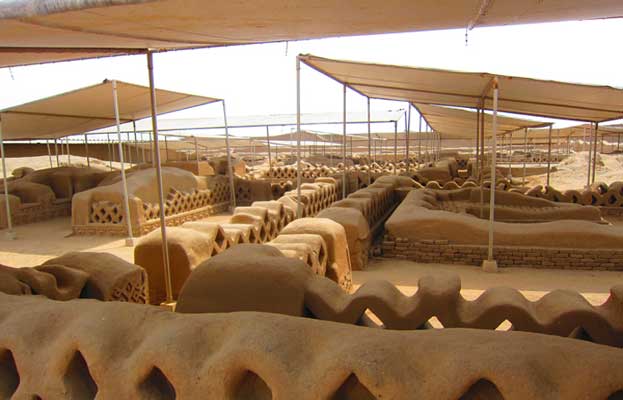
The Chimu Kingdom, with Chan Chan as its capital, reached its apogee in the 15th century, not long before falling to the Incas. The planning of this huge city, the largest in pre-Columbian America, reflects a strict political and social strategy, marked by the city's division into nine 'citadels' or 'palaces' forming autonomous units. The Chimu Kingdom reached its apogee in the 15th century, not long before falling to the Incas. Its capital Chan Chan, located in the once fertile river valley of Moche or Santa Catalina, was the largest earthen architecture city in pre-Columbian America. The remains of this vast city reflect in their layout a strict political and social strategy, emphasized by their division into nine 'citadels' or 'palaces' forming independent units. In 1986 the Chan Chan Archaeological Zone Peru inscribed as UNESCO World Heritage Sites and now it is in danger list.

Chan Chan Archaeological Zone
Continent: South America
Country: Peru
Category: Danger List
Criterion: (I)(III)
Date of Inscription: 1986

The monumental zone

The Outstanding Universal Value of Chan Chan resides in the extensive, hierarchically planned remains of this huge city, including remnants of the industrial, agricultural and water management systems that sustained it. The monumental zone of around six square kilometres in the centre of the once twenty square kilometre city, comprises nine large rectangular delineated by high thick earthen walls. Within these units, buildings including temples, dwellings and storehouses are arranged around open spaces, together with reservoirs, and funeral platforms.

Chan Chan Archaeological Zone Peru

Browse Gallery Plus UNESCO Storyline

Around the City

The earthen walls of the buildings were often decorated with friezes representing abstract motifs, and anthropomorphical and zoomorphical subjects. Around these nine complexes were thirty two semi monumental compounds and four production sectors for activities such as weaving wood and metal working. Extensive agricultural areas and a remnant irrigation system have been found further to the north, east and west of the city.

The Moche and Chicama rivers once supplied an intricate irrigation system via an approximately 80 kilometre long canal, sustaining the region around Chan Chan during the height of the Chimu civilisation.

Slideshow for this Heritage Site


Browse All UNESCO World Heritage Sites in . The original UNESCO inscription Here!!!

#1000 Machu Piccu, Peru

View from Machu Piccu back toward the small town of Aguas Calientes.
Waking up at an ungodly hour to join the line for the bus in Aguas Calientes, and driving along the sheer canyon of the Rio Urubamba, marveling at how much water and the fast current in it, and seeing the Hiram Bingham Memorial Highway rise up the steep face of the jungle walls is an impressive journey in itself, but to be capped with stepping out of the trees and having the intact, ancient, organized stone walls emerge laid out below you is all of what makes Machu Picchu such an amazing experience. Machu Picchu's ruins are impressive in their own right, but to be placed in such an incredible, inaccessible place is what makes them such a part of every traveler's checklist.

First viewed from afar or visited by foreigners at the end of the 1800s (see wikipedia), but made famous by Hiram Bingham of Yale University (which also holds many of the artifacts from there) it was made accessible by in insanely windy, steep road in the 1950s/60s. Thousands visit each day, so many that the Peruvian government capped it in recent years, requiring (a limited number of) tickets for entry. Whether you choose to walk up from town, or climb either Huaynapicchu (the steep cliff behind the famous photo) or the Machu Picchu Montana (behind you in the famous photo), or just visit the ruins and museum itself, you will have an amazing time. Even the most hardened voyager cannot help but be impressed that such a city was built in such a place, surrounded by such beauty.

The Incas, famous for being one of the most important pre-Columbian civilizations of South America, was actually quite short lived in comparison to many civilizations (only a few hundred years). Their constructions were incredible because of the lack of mortar used and stability that continues through earthquakes, and the sheer size of many of the stones they used.

Machu Picchu is amazing because all buildings are almost exactly as they were when the residents left because the Spanish didn't discover or conquer it. Some stones crumbled, and jungle grew over much of it, but otherwise it gives us a view into how it was. It's also amazing because of it's inaccessibility and defensibility. Only 8 paths led in, one of which was the Inca bridge past a sheer cliff (shown at right). Another is the famous Inca Trail which leads up from the Rio Urubamba several turns back along the river to pass high over the mountains to form complex trade routes. The city included agricultural, residential, religious and municipal areas, and was militarily well-equipped. Amazing!


Huacachina

Huacachina is a village in the Ica region, in southwestern Peru, and built around a small natural lake in the desert. This place is known by the name Oasis of the Americas, and is a popular resort among local and foreign tourists.

The origin of this place according to local story that circulated was that the lake was formed when the young hunter disturbing a beautiful princess who was in the shower. The daughter immediately went away leaving a pool of water that later became lakes.

Now, owners of private land near the oasis has been made well, to access ground water. This has the effect of drastically reducing the level of water in the oasis. Besides this place became popular and good for buggying bumps and Sandboarding.

Machu Picchu

Machu Picchu ("Old Mountain" in Quechua language, often also called "the lost Inca City") is a site of pre-Columbian Inca ruins located in the mountainous region at an altitude of about 2350 m. Machu Picchu is located above the Urubamba Valley in Peru, about 70 km northwest of Cusco.


This site was forgotten by the international community, but not by the local community. This site re-discovered by archaeologists from the university YaleHiram Bingham III rediscovered in 1911. Peru then do the legal efforts to retrieve artifacts taken by Bingham from the site. Since then, Machu Picchu became a tourist attraction that attracts local and foreign tourists.
The site has been designated as a UNESCO World Heritage Site since 1983, Machu Picchu is also one of the new Seven Wonders of the World, is also receiving attention due to damage caused by tourism (the number of visitors reached 400,000 in 2003).

Machu Picchu was built by the ancient Incan style with walls of polished stone. The main building is Intihuatana, the Temple of the Sun, and Three Window Room. These places are referred to as the Sacred District of Machu Picchu.