The cultural landscape of Sukur has survived unchanged for many centuries, and graphically illustrates a form of land use that marks a critical stage in human settlement and its relationship with its environment. Situated on a plateau in north-eastern Nigeria, near the frontier with Cameroon, it has been occupied for centuries, and its inhabitants have left abundant traces on the present-day landscape.

Continent: Africa
Country: Nigeria
Category: Cultural
Criterion: (III)(V) (VI)
Date of Inscription: 1999
The House complex of the Hidi
The Hidi's Palace or house complex of the Hidi (chief), the harem section of which is now in ruins, is of considerable political and religious significance for the Sukur people. The evidence for Neolithic occupation of Sukur is slight, but a pre-Sukur Iron Age phase is shown by finds of furnaces, ore and grindstones. The buildings that make up the circular enclosure are relatively simple in design, and constructed of the local granite. Some of the large stones, such as the monoliths that flank one of the gates, are very large and were brought to the site over long distances.The present Dur dynasty of chiefs was established in the 17th century. It saw Sukur becoming a major iron-producing region, supplying north-eastern Nigeria with a vital raw material. This phase continued until the first decade of the 20th century. However, between 1912 and 1922 Sukur was subjected to raids and devastation at the hands of Hamman Yaje, the Fulbe Lamido (chief) of nearby Madagali. Iron smelting continued to decline in the colonial and independence period, ending around 1960. As a result there were substantial migrations of Sukur people from the plateau to the plains lying to north and south.
 |
| The cultural landscape of Sukur Nigeria |
Browse Gallery Plus UNESCO Storyline
Leading up to the palace complex from the north and east are paved walkways, 5-7 m wide, made from slabs of the same granite that was used within the palace itself. Within and around the complex there are also paved paths, but composed of much larger slabs. The domesticated landscape of the Sukur plateau is characterized by the extensive terracing, of a type known elsewhere in Nigeria. However, the Sukur terraces have a sacred quality that is lacking in these purely functional terraced landscapes, and they are the product of social organizations whose working parties maintained and progressively extended them.
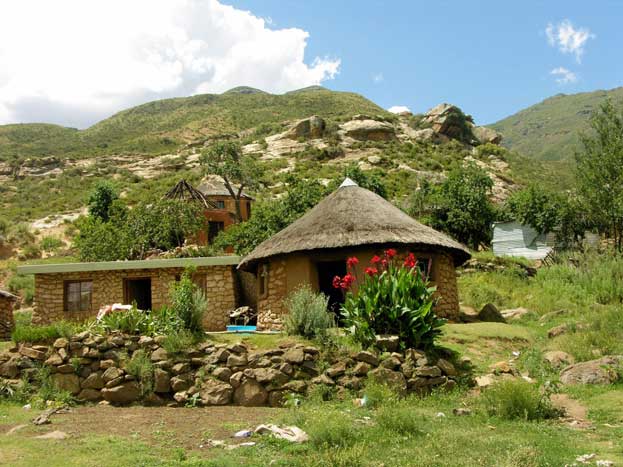
While primarily intended to provide level areas for agriculture, they are invested with a spiritual significance, as shown by the sacred trees, entrances and ritual sites within them. The villages, situated on low-lying ground below the Hidi Palace, have their own domestic architecture of drystone walls, used as social markers and defensive enclosures, sunken animal pens, granaries and threshing floors. Again, local granite is the main source of constructional materials. The living huts are simple circular structures made from clay with roofs of thatch and woven mats. Integrated groups are surrounded by low drystone walls.
The traditional cemeteries are to be found in the hills. The tombs are simple stone structures, and different clans and social groups had their own cemeteries. The only exceptions were for the Hidi, whose bodies were buried within their own palace complexes, and children, buried close to the settlement. Of considerable social and economic importance are the wells - below ground, surmounted by conical stone structures and surrounded by an enclosure wall. Within these domestic animals such as cattle and sheep were fattened, for consumption by the family or as status symbols used in gift and marriage exchanges.
The remains of many disused iron-smelting furnaces can still be found. These shaft-type furnaces, blown with bellows, were usually sited close to the houses of their owners. It is clear that iron production involved complex socio-economic relationships and that there was a considerable ritual associated with it.
There are a number of shrines and altars, many of them ceramic, in the Sukur cultural landscape particularly in and around the Hidi Palace. The landscape as a whole is an integrated one, which symbolizes the political and economic structure of the Sukur people. Authority, in the form of the Hidi, is located in an elevated position overlooking the mass of the people in their low-lying villages. Complex social relationships can be observed in the disposition of the cemeteries, while the relationships between iron furnaces and settlements and within the agricultural terraces illustrate an elaborate economic pattern of production and distribution.
Browse All UNESCO World Heritage Sites in
Nigeria. The original UNESCO inscription
Here!!!


