Pages

Showing posts with label Heritage Monuments. Show all posts

The Historic Centre of Macao in China

The Historic Centre of Macao was settled by fishing people long before the arrival of foreigners. It was a sheltered bay on the peninsula and a stopping point for seafarers sailing down the Chinese coast from Fujian province. The temple for the Goddess A-Ma, built in the late 15th century, is testimony to their faith. The Portuguese first arrived to China in 1513, visiting the famous market of Canton. In 1557, they arrived in Macao, which became the oldest permanent European settlement in East Asia.

The Historic Centre of Macao in China
Continent: Asia
Country: China
Category: Cultural
Criterion: (II)(III) (IV) (VI)
Date of Inscription: 2005

Historic Centre of Macao

The name of Macao derives from the Ma Kwok temple, built in the 14th century. At the time, the native inhabitants were scattered in small villages. Barra village and Patane village were small settlements of seafaring merchants, while the other villagers were farmers. When the Portuguese arrived, they built simple timber-clay houses in the Inner Harbour area. Several catholic churches and chapels gave the character for the settlement, becoming the focal points for road patterns. In the early 17th century, the Portuguese built a series of forts against other Western powers, e.g. the Dutch. In mid-17th century, the settlement was divided into two parts: the Portuguese in the south and the Chinese in the north. There was relatively little development in the 18th century due to restrictive legislation by the Chinese authorities.

In 1849, Portugal proclaimed Macao a free port, which was confirmed in a protocol in 1887. In the late 18th and early 19th centuries, the Catholic Church increased its power constructing new or renovating major churches. Due to Macao's role as a trading base, and due to lucrative opium trade, foreign companies established a base in an enclave prior to heading further up the Pearly River to Canton. This increased the quality of the building construction.

The Historic Centre of Macao in China Heritage
The Historic Centre of Macao in China

Browse Gallery Plus UNESCO Storyline

At the end of the 19th century, not being able to compete with Hong-Kong, Macao's main finances were based on offering a popular sojourn spot for foreigners. As a result, many luxurious villas were built here, including new functions and buildings, such as Dom Pedro V Theatre, the Military Club, the Moorish Barracks, and Bela Vista Hotel. At the same time, the Chinese continued building in their own style, including Earth God Temple, the God of Justice Temple, Na Tcha Temple, and A-Ma Temple. From this period, there also started the process of land reclaim, which continued through the 20th century, providing a substantial extension to urbanised area.

Slideshow for this Heritage Site


After 1949 the population grew especially by an influx of Chinese refugees from the mainland. In 1974, Macao was established as a Chinese territory under Portuguese administration. Under the terms of the 1987 agreement, Macao became a special administrative region under Chinese sovereignty in December 1999. In the 1990s, there has been a real-estate boom, resulting in a large number of high-rise buildings in the city centre area, though principally outside the defined buffer zones. At the same time, there have been campaigns for the restoration of the historic monuments.

Browse All UNESCO World Heritage Sites in . The original UNESCO inscription Here!!!

Sun Temple Konarak Orissa

Sun Temple, Konarak is located on the shores of the Bay of Bengal, bathed in the rays of the rising sun, the temple at Konarak is a monumental representation of the sun god Surya's chariot; its 24 wheels are decorated with symbolic designs and it is led by a team of six horses. Built in the 13th century, it is one of India's most famous Brahman sanctuaries. Konarak is an outstanding testimony to the 13th-century kingdom of Orissa. It is directly and materially linked to Brahmin beliefs, and forms the invaluable link in the history of the diffusion of the cult of Surya, which originated in Kashmir during the 8th century and finally reached the shores of eastern India.

Sun Temple Konarak Orissa India
Continent: Asia
Country: India
Category: Cultural
Criterion: (I)(III) (VI)
Date of Inscription: 1984

Brahmin temple of Kimarak

On the eastern coast of India, south of the Mahanadi Delta, is the Brahmin temple of Kimarak (still spelled as Konarak or Konarka), one of the most famous Brahmin sanctuaries of Asia. Konarak derives its name from Konarka, the presiding deity of the Sun Temple. Konarka is a combination of two words, kona (corner) and arka (Sun). It was one of the earliest centres of Sun worship in India. Built around 1250 in the reign of King Narasingha Deva (1238-64), it marks the apogee of the wave of foundations dedicated to the Sun God Surya; the entire temple was conceived as a chariot of the Sun God with a set of spokes and elaborates carvings.

The present Sun Temple was probably built by King Narashimhadev I (1238-64) of the Ganga dynasty to celebrate his victory over the Muslims. The temple fell into disuse in the early 17th century after it was desecrated by an envoy of the Mughal Emperor Jahangir. The legend has it that the temple was constructed by Samba, the son of Lord Krishna. Samba was afflicted by leprosy and after twelve years of penance he was cured by Surya, the Sun God, in whose honour he built this temple.

Sun Temple Konarak Orissa
Sun Temple Konarak

Browse Gallery Plus UNESCO Storyline

Against the horizon, on the sandy shore, where the rising Sun emerges from the waters of the Gulf of Bengal, stands the temple, built from stone and carefully oriented so as to permit the first rays of the Sun to strike its principal entry. It is a monumental representation of the chariot of Surya pulled by a team of seven horses (six of which still exist and are placed on either side of the stairway leading to the sanctuary).

Slideshow for this Heritage Site


On the north and south sides, 24 wheels some 3 m in diameter, lavishly sculptured with symbolic motives referring to the cycle of the seasons and the months, complete the illusionary structure of the temple-chariot. Between the wheels, the plinth of the temple is entirely decorated with reliefs (fantastic lions, musicians and dancers, erotic groups). Like many Indian temples, Konarak comprises several distinct and well-organized spatial units.

The vimana (principal sanctuary) was surmounted by a high tower with a sikkara which was razed in the 19th century; to the east, the jahamogana (audience hall) now dominates the ruins with its pyramidal mass, the original effect.

Further to the east, the natmandir (dance hall), today unroofed, rises on a high platform. Various subsidiary structures are still to be found within the enclosed area of the rectangular wall, which is punctuated by its gates and towers.

Apart from the Puranas, other religious texts also point towards the existence of a Sun temple at Konarak long before the present temple. Konarak was once a bustling port of Kalinga and had good maritime trade relations with South-East Asian countries.

Browse All UNESCO World Heritage Sites in . The original UNESCO inscription Here!!!

Sandstone Tower of Qutb Minar and its Monuments

Qutb Minar was built in the early 13th century a few kilometres south of Delhi; the red sandstone tower of Qutb Minar is 72.5 m high, tapering from 2.75 m in diameter at its peak to 14.32 m at its base, and alternating angular and rounded flutings. The surrounding archaeological area contains funerary buildings, notably the magnificent Alai-Darwaza Gate, the masterpiece of Indo-Muslim art (built in 1311), and two mosques, including the Quwwatu'l-Islam, the oldest in northern India, built of materials reused from some 20 Brahman temples.

Sandstone Tower of Qutb Minar and its Monuments
Continent: Asia
Country: India
Category: Cultural
Criterion: (IV)
Date of Inscription: 1993

The Qutb Complex

Lalkot is the first of the seven cities of Delhi, established by the Tomar Rajput ruler, Anang Pal, in 1060. The Qutb complex lies in the middle of the eastern part of Lalkot. Building of the Quwwatu'l-Islam (Might of Islam) congregational mosque was begun in 1192 by Qutbu'd-Din Aibak and completed in 1198, using the demolished remains of Hindu temples. It was enlarged by Iltutmish (1211-36) and again by Alauld-Din Khalji (1296-1316).

The Qutb Minar was also begun by Qutbu'd-Din Aibak, in around 1202 and completed by his successor, Muhammad-bin-Sam. It was damaged by lightning in 1326 and again in 1368, and was repaired by the rulers of the day, Muhammad-bin-Tughluq (1325-51) and Firuz Shah Tughluq (1351-88). In 1503 Sikandar Lodi carried out some restoration and enlargement of the upper storeys. The iron pillar in the mosque compound was brought from elsewhere in India.

Sandstone Tower of Qutb Minar and its Monuments Delhi India
Qutb Minar

Browse Gallery Plus UNESCO Storyline

It bears a Sanskrit inscription from the 4th century AD describing the exploits of a ruler named Chandra, believed to be the Gupta King Chandragupta II (375-413). Of the other monuments, the Tomb of Iltutmish was built in 1235 by the ruler himself and Alai Darwaja was built in 1311 by Alauld-Din Khalji, who also began the construction of the Alai Minar.

Slideshow for this Heritage Site


The Quwwatu'l-Islam mosque consists of a courtyard, cloisters, and a prayer hall. The high arched screen facing the prayer hall was added in the 14th century. The Qutb Minar is a column built from red and buff sandstone blocks rising to a height of 72.5 m, tapering from 2.75 m diameter at the top to 14.32 m at the base, making it the highest stone tower in India.

In addition to its traditional use for calling the faithful to prayer, it also has a monumental purpose, since a later Nagari inscription calls it Alauld-Din's 'victory monument' (Vijava-stambha). In its present form it consists of five storeys, the topmost of the original four storeys having been replaced by two storeys during the reign of Firuz Shah Tughluq. Each storey is separated from the next by highly decorated balconies, with pendentives and inscribed bands. The three earlier storeys are each decorated differently, the lowest being of alternating angular and rounded flutings, the second with rounded flutings alone, and the third with angular flutings alone; the same vertical alignment continues, however, through all three storeys.

The whole structure was originally surmounted by a cupola, which fell during an earthquake and was replaced by a new cupola in late Mughal style in the early 19th century. This was so incongruous that it was removed in 1848 and now stands on the lawns to the south-east of the minaret.

The Iron Pillar is 7.02 m long, 0.93 m of which is below ground. It is built up of many hundreds of small wrought-iron blooms welded together and is the largest known composite iron object from so early a period. The remarkable lack of corrosion is attributable to the combination of several factors, among them the high corrosion-resistance of wrought iron, the climatic conditions in Delhi, and the likelihood that it was frequently anointed with ghee (melted butter).

The deep cavity at the top suggests that it may at one time have been crowned by a Garuda image. The ornate Tomb of Iltutmish is in the north-west corner of the mosque. It consists of a square chamber of red sandstone with the tomb itself in the centre on a raised platform. The lower part of the interior is covered with fine Islamic carvings and arabesques. There is a marble mihrab (prayer niche) in the centre of the interior west wall.

The Alai Darwaza, built from red sandstone and elaborately carved, is the southern entrance to the enlarged enclosure of the Qutb complex. The Alai Minar, to the north of the enclosure, is the base of a second minaret which was to overtop the Qutb Minar. It was begun by Alau'd-Din-Khalji, but he died before it reached the first storey and work on the structure was abandoned.

Browse All UNESCO World Heritage Sites in . The original UNESCO inscription Here!!!

Humayun's Tomb India

Humayun's Tomb, built in 1570, is of particular cultural significance as it was the first garden-tomb on the Indian subcontinent. It inspired several major architectural innovations, culminating in the construction of the Taj Mahal. Exemplifying the formative stage of the Mughal structural style, Humayun's Tomb stands as a landmark in the development of Mughal architecture, and also represents the earliest extant specimen of the Mughal scheme of the garden tomb, with causeways and channels. It is a well-developed specimen of the double-domed elevation with kiosks on a grand scale. This building tradition culminated in the Taj Mahal, constructed a century later. Despite being the first standardized example of this style, Humayun's Tomb is an architectural achievement of the highest order.

Humayun's Tomb India
Continent: Asia
Country: India
Category: Cultural
Criterion: (II)(IV)
Date of Inscription: 2011

The Tomb of Humayun

The tomb of Humayun, second Mughal Emperor of India, was built by his widow, Biga Begum (Hajji Begum), in 1569-70, 14 years after his death, at a cost of 1.5 million rupees. The architect was Mirak Mirza Ghiyath. It was later used for the burial of various members of the ruling family and contains some 150 graves. It has aptly been described as the necropolis of the Mughal dynasty.

The tomb itself is in the centre of a large garden, laid out in char baah (four-fold) style, with pools joined by channels. The main entrance is on the south side, and there is another entrance on the west side. A pavilion and a bath are located in the centre of the eastern and northern walls respectively. The mausoleum itself is on a high, wide, terraced platform with small arched cells along the sides.

The Tomb of Humayun
The Humayun Tomb India

Browse Gallery Plus UNESCO Storyline

In plan it is an irregular octagon with four long and four short sides. It is surmounted by a 42.5 m high double dome clad with marble flanked by decorative pillared kiosks (chhatris). The middle of each side is deeply recessed by large arched vaults with a series of smaller ones set into the face. The interior is a large octagonal chamber with vaulted roof compartments interconnected by galleries or corridors. This octagonal plan is repeated on the second storey. The structure is of dressed stone clad in red sandstone with white and black in laid marble borders. Within the enceinte to the south-east of Humayun's Tomb there is a fine square tomb of 1590-91, known as the Barber's Tomb.

Slideshow for this Heritage Site


The tomb and its surrounding structures are substantially in their original state, and interventions in the present century have been minimal and of high quality.

The importance of Humayun's Tomb in the evolution of Mughal architecture is great. It is the first of a long series of dynastic tombs and innovative in a number of ways, notably by virtue of the fact that it introduced the garden tomb to the subcontinent. Humayun had travelled widely in the Islamic world, notably in Persia and central Asia, and brought back with him ideas that were applied by the architect of his tomb, under the direction of his widow, in this tomb. The tomb has been respected throughout its history and so has retained its original form and purpose intact. Subsequent interventions have been aimed at preserving this character.

Browse All UNESCO World Heritage Sites in . The original UNESCO inscription Here!!!

The City of Victory

Built during the second half of the 16th century by the Emperor Akbar, Fatehpur Sikri or the City of Victory was the capital of the Mughal Empire for only some 10 years. The complex of monuments and temples, all in a uniform architectural style, includes one of the largest mosques in India, the Jama Masjid. Fatehpur Sikri bears exceptional testimony to the Mughal civilization at the end of the 16th century. It offers a unique example of architectural ensembles of very high quality constructed between 1571 and 1585. Its form and layout strongly influenced the evolution of Indian town planning, notably at Shahjahanabad (Old Delhi).

Fatehpur Sikri or the City of Victory
Continent: Asia
Country: India
Category: Cultural
Criterion: (II)(III) (IV)
Date of Inscription: 1986

Fatehpur Sikri

The 'City of Victory' had only an ephemeral existence as the capital of the Mughal Empire. The Emperor Akbar (1556-1605) decided to construct it in 1571, on the same site where the birth of his son, the future Jahangir, was predicted by the wise Shaikh Salim Chisti (1480-1572). The work, supervised by the great Mughal himself, was completed in 1573. In 1585, however, Akbar abandoned Fatehpur Sikri to fight against the Afghan tribes and choose a new capital, Lahore. Fatehpur Sikri was to be the seat of the great Mughal court only once more for three months in 1619, when Jahangir sought refuge there from the plague that devastated Agra. The site was then finally abandoned, until its archaeological exploration in 1892.

This capital without a future, some 40 km from Agra was, however, considerably more than the fancy of a sovereign during the 14 years of its existence. The city, which the English traveller Ralph Fitch considered in 1585 as 'considerably larger than London and more populous', comprised a series of palaces, public buildings and mosques, as well as living areas for the court, the army, servants of the king and for an entire population whose history has not been recorded.

Fatehpur Sikri India

Browse Gallery Plus UNESCO Storyline

Only one tiny part of the city (where the large buildings are concentrated) has been until now, studied, visited and relatively well preserved. Fatehpur Sikri, constructed on a rocky plateau, south-east of an artificial lake, created for the occasion and today partially dried up, is bounded on three sides by a 6 km wall, fortified by towers and pierced by seven gates (the best preserved is the Gate of Agra, the second from the north). This spacious enclosure defines the limits of the new foundation rather than assuring its defence.

The majority of the important monuments are found to the north of the road from Gaza to Agra; constructed of red sandstone, they form a homogeneous group, even if the eclecticism of their style is evident and is based on borrowings from Hindu, Persian and Indo-Muslim traditions. Among the numerous palaces, gazebos, pavilions, etc., may be cited in particular:

Slideshow for this Heritage Site


Diwan-i-Am, the Hall of Public Audience, is encircled by a series of porticos which are broken up by the insertion of the imperial box where Akbar, surrounded by his ministers and officers meted out justice. This box communicates directly with Daulat Khana (Imperial Palace), flanked to the north by Diwan-i-Kas (Hall of Private Audience), called the 'Jewel House', a monument known for its central plan, which comprises an extraordinary capital surmounted by a circular balcony: the 'throne'.

Other monuments of exceptional quality are the Ranch Mahal, whose elevation of four recessed storeys recalls certain Buddhist temples, the pavilion of Anup Talao, or the Turkish Sultana, the palace of Jodh Bai, the palace of Birbal, the caravanserai and the problematic 'stables'.

Owing to the piety of Akbar, many religious and votive monuments were constructed at Fatehpur Sikri. The great mosque (Jama Masjid), one of the most spacious in India (165 m by 133 m) could accommodate some 10,000 faithful; it was completed in 1571-72 and according to the dedicatory inscription deserves no less respect than Mecca. It incorporates, in the centre of the court, the tomb of Shaikh Salim, an extraordinary Christian masterpiece of sculpted decoration, further embellished under the reign of Jahangir

To the south of the court, the Buland Damaza, completed in 1575, commemorating the victories (the taking of Gujarat in 1572) to which the city, their monumental symbol, owes its existence and its name.

Browse All UNESCO World Heritage Sites in . The original UNESCO inscription Here!!!

Ellora Caves Monasteries and Temples

The 34 Ellora Caves Monasteries and Temples, extending over more than 2 km, were dug side by side in the wall of a high basalt cliff, not far from Aurangabad, in Maharashtra. Ellora, with its uninterrupted sequence of monuments dating from A.D. 600 to 1000, brings the civilization of ancient India to life. Not only is the Ellora complex a unique artistic creation and a technological exploit but, with its sanctuaries devoted to Buddhism, Hinduism and Jainism, it illustrates the spirit of tolerance that was characteristic of ancient India.

Ellora Caves Monasteries and Temples
Continent: Asia
Country: India
Category: Cultural
Criterion: (I)(III) (VI)
Date of Inscription: 1983

The Ellora Caves

The Ellora Caves not only bear witness to three great religions (Buddhism, Brahminism and Jainism) but they also illustrate the spirit of tolerance, characteristic of ancient India, which permitted these three religions to establish their sanctuaries and their communities in a single place, which thus served to reinforce its universal value. The caves, with their uninterrupted sequence of from 600 to 1,000 monuments, bring to life again the civilization of ancient India.

These 34 monasteries and temples, extending over more than 2 km, were dug side by side in the wall of a high basalt cliff, not far from Aurangabad, in Maharashtra. Ellora, with its uninterrupted sequence of monuments dating from AD 600 to 1000, brings the civilization of ancient India to life. Not only is the Ellora complex a unique artistic creation and a technological exploit but, with its sanctuaries devoted to Buddhism, Hinduism and Jainism, it illustrates the spirit of tolerance that was characteristic of ancient India.

The Ellora Caves India

Browse Gallery Plus UNESCO Storyline

This rupestral ensemble constitute one of the most beautiful expressions of the art of the Indian Middle Ages; they are noteworthy as three major Indian religions have laid joint claim to the caves peacefully since they were created. These breathtaking caves are definitely worth visiting for their remarkable reliefs, sculptures and architecture. It is not, like that of Ajanta, the expression of a single belief; rather it is the product of the three principal religions of ancient India.

Progressing from south to north along the cliff, one discovers successively the twelve caves of the Buddhist group, which appear to be the oldest (between c. 600 and 800) and comprise monasteries and a single large temple (cave 10); then the caves of the Brahmin group (c. 600 to 900) which are no doubt the best known of Ellora with the 'Cavern of the Ten Avatars' (cave 15) and especially the Kailasha Temple (cave 16), an enormous complex, most likely undertaken during the reign of Krishna I (757-83); and, finally, the Jain group (caves 30-34) whose sanctuaries were created by the sect of the Digambara towards AD 800-1000, The Jain caves, the last to be excavated, drew their inspiration from the art already existing at Ellora: cave 32 recalls by certain of its dispositions the Kailasha Temple.

Slideshow for this Heritage Site


The Buddhist Caves were excavated between the 5th and the 7th centuries AD, when the Mahayana sects were flourishing in the region; among these cave 5 is the largest. Cave 10 is a chaitya hall and is popularly known as 'Visvakarma'. It has a highly ornamental facade provided with a gallery and in the chaitya hall there is a beautiful image of Buddha set on a stupa.

The historical value of cave 12 or Tin Tala lies in the fact that human hands built a three-storeyed building from rock with such painstaking skill that even the floors and the ceiling are smooth and levelled. Tin Tala cave is a monastery-cum-chapel, with cells. It dates to the Rashtrakuta period in the mid-8th century.

The Brahmin caves are mostly Saivite. Kailasa (cave 16) is a remarkable example of rock-cut temples in India on account of its striking proportion; elaborate workmanship architectural content and sculptural ornamentation. It is said that cave 16 have been started by the Rashtrakuta king, Krishna I, and it is dedicated to Shiva and named after his mountain home in the Himalaya, the snow-peak Kailasa.

The whole temple consists of a shrine with lingam at the rear of the hall with Dravidian sikhara, a flat-roofed mandapa supported by sixteen pillars, a separate porch for Nandi surrounded by an open court entered through a low gopura. The grand sculpture of Ravana attempting to lift Mount Kailasa, the abode of Siva, with his full might is a landmark in Indian art.

The Jain Caves are massive, well-proportioned, decorated and mark the last phase of the activity at Ellora.

Browse All UNESCO World Heritage Sites in . The original UNESCO inscription Here!!!

City of Caves

The 'City of Caves', on an island in the Sea of Oman close to Bombay, contains a collection of rock art linked to the cult of Shiva. Here, Indian art has found one of its most perfect expressions, particularly the huge high reliefs in the main cave. The island of Elephanta, the glorious abode of Lord Shiva and an epitome of Hindu cave culture, consists of seven caves on an island in the Sea of Oman close to Mumbai which, with their decorated temples and the images from Hindu mythology, bear a unique testimony to a civilization that has disappeared. Here, Indian art has found one of its most perfect expressions, particularly in the huge high reliefs in the main cave.

Elephanta Caves Maharashtra India
Continent: Asia
Country: India
Category: Cultural
Criterion: (I)(III)
Date of Inscription: 1987

Elephanta Caves

The island of Gharapuri, the 'City of Caves', situated about 10 km from Mumbai on the east side of the harbour, owes its name to the enormous stone elephant found there by Portuguese navigators. This elephant was cut into pieces, removed to Mumbai and somehow put together again. It is today the melancholy guardian of Victoria Gardens Zoo in Mumbai, the great metropolis of Maharashtra State and India's second city population-wise. The date of the famous Elephanta Caves is still very much debated and varies from the 6th century to the 8th century according to different specialists.

They constitute one of the most striking collections of rock-art in India. There are two groups of caves. To the east, Stupa Hill (thus named because of a small brick Buddhist monument at the top) contains two caves, one of which is unfinished, and several cisterns. To the west, the larger group consists of five rock-cut Hindu shrines. The main cave is universally famous for its carvings to the glory of Shiva, who is exalted in various forms and act ions. The cave consists of a square plan mandapa whose sides measure about 27 m.

Elephanta Caves Maharashtra
Elephanta Caves India

Browse Gallery Plus UNESCO Storyline

The interior is divided up into smaller areas by rows of supports. The whole shape carefully imitates a building; false profiled beams have been carved in the roof of the cave and the supports, which are complex structures, combine, from bottom to top, the shapes of the pillars, columns and capitals found in bonded stone architecture.

At the very entrance to the cave, to the north of an esplanade reached by a steep flight of steps, the pilgrim or visitor to this high place of Shivaism is greeted by two large carved panels depicting, on the left, Shiva Yogisvara (Master of Yoga) and, on the right, Shiva Nataraja (King of Dance), both treated in a monumental style still close to that of the Gupta period. In a chapel on the right of the entrance stands the cylindrical lingam, symbol of the Supreme Being and principle of all energy.

Slideshow for this Heritage Site


This chapel has four doors, each flanked by colossal figures of dvarapala, those mediator guardians whose task was to admit the faithful and keep out ill-intentioned visitors. On each wall of the mandapa, enormous high-reliefs (maximum height 5.70 m) present further pictures of Shiva. Opposite the entrance, on the south wall, is the famous and unforgettable three-headed bust of the Mahadeva, whose three faces are the incarnation of three essential functions; to the east, Aghora or Bhairava, terrifying destroyer; to the west, Vamadeva, creator of joy and beauty, incarnated by a woman's head; and in the centre, Tatpurusha, master of positive and negative principles of existence and preserver of their harmony.

On either side of this central figure there are two other reliefs depicting, on the left, androgynous Shiva (Ardhanarisvara) and, on the right, Shiva receiving the waters of the Ganges (Gangadhara). Ten other reliefs, placed in each angle of the main hall and in the aisles to the east and west, depict further episodes from the legend of Shiva, such as the marriage of Shiva to Parvati, Shiva killing the devil Andhaka, etc. The 15 large reliefs surrounding the lingam chapel in the main Elephanta Cave not only constitute one of the greatest examples of Indian art but also one of the most important collections for the cult of Shiva.

Browse All UNESCO World Heritage Sites in . The original UNESCO inscription Here!!!

Group of Buddhist Monuments Sanchi

On a hill overlooking the plain and about 40 km from Bhopal, the site of Sanchi comprises a group of Buddhist monuments (monolithic pillars, palaces, temples and monasteries) all in different states of conservation most of which date back to the 2nd and 1st centuries B.C. It is the oldest Buddhist sanctuary in existence and was a major Buddhist centre in India until the 12th century A.D. From the time that the oldest preserved monument on the site (Asoka's column with its projecting capital of lions inspired by Achaemenid art) was erected, Sanchi's role as intermediary for the spread of cultures and their peripheral arts throughout the Maurya Empire, and later in India of the Sunga, Shatavahana, Kushan and Gupta dynasties, was confirmed.

Group of Buddhist Monuments Sanchi
Continent: Asia
Country: India
Category: Cultural
Criterion: (I)(II) (III)(IV) (VI)
Date of Inscription: 1989

Oldest extant Buddhist Sanctuary

Sanchi is the oldest extant Buddhist sanctuary. Although Buddha never visited the site during any of his former lives or during his earthly existence, the religious nature of this shrine is obvious. The chamber of relics of Stupa 1 contained the remains of Shariputra, a disciple of Shakyamuni who died six months before his master; he is especially venerated by the occupants of the 'small vehicle' or Hinayana. Having remained a principal centre of Buddhism in medieval India following the spread of Hinduism, Sanchi bears unique witness as a major Buddhist sanctuary to the period from the 3rd century BC to the 1st century AD.

When it was discovered in 1818 by General Taylor, Sanchi had lain abandoned for 600 years. The site, 45 km from Bhopal, was overrun with vegetation. Excavations began in somewhat disorganized fashion until the Archaeological Survey of India stepped in and took control. Gradually, as the hill was cleared, the ruins of about 50 monuments were uncovered, revealing one of the most remarkable archaeological complexes in India.

Oldest extant Buddhist Sanctuary
Buddhist Sanctuary Sanchi

Browse Gallery Plus UNESCO Storyline

It would appear that the site was settled in the 3rd century BC at the time that the Emperor Asoka, the grandson of Chandragupta, who had defeated the Macedonian invaders and founded the Maurya dynasty, was converted to Buddhism (c. 250 BC). Asoka, whose queen was from the neighbouring town of Vidisha, founded, or at least embellished, a Buddhist sanctuary located at Sanchi.

He also had a stone column more than 12 m high erected with his edicts carved on it. To the south of Asoka's column and predating it is an early brick stupa about 20 m in diameter and crowned with stone aedicula; a wooden railing encircles it. Now known as Stupa 1, this monument was enlarged under the Sunga and the Andhra dynasties (2nd and 1st centuries BC) and is the principal monument at Sanchi.

Slideshow for this Heritage Site


It consists of a gigantic mound of sandstone surrounded by sumptuous porticoes with stone railings; it's hemispherical dome measures 36.6 m in diameter and is 16.46 m high. It is particularly famous for the extraordinarily rich decorative work on the four monumental gateways (torana) that provide access. Positioned almost exactly in line with the four cardinal points, these gateways transpose into stone the structure of the wooden gateways: two pillars and three architraves reproduce the assembly of two posts joined by three rails.

The lush carvings, prodigious creations in bas relief, high relief and in the round, are an iconographic treasure trove. The essential theme represented in the decorative work revolves around the former lives of Buddha. Numerous other themes were taken from legends and history.

The fresh, wonderfully charming representations of plants, animals and humans, the narrative quality of the stories and the creativity apparent in the fantastic sculptured capitals and cornices combine to make this an unrivalled masterpiece of early Buddhist art. Sanchi has two other famous stupas dating from the Sunga period (2nd century BC). The torana of Stupa 3, executed in the 1st century, are exceptional works.

Many other structures are found on the site: within the ruins of a wall dating from the 11th-12th centuries, Sanchi's final years are represented by monolithic pillars, palaces, temples and monasteries, all in varying states of preservation. Temples 17 and 45 and monastery 51 are among the most impressive structures.

Browse All UNESCO World Heritage Sites in . The original UNESCO inscription Here!!!

Palace fort of Shahjahanabad

The Red Fort Complex was built as the palace fort of Shahjahanabad – the new capital of the fifth Mughal Emperor of India, Shah Jahan. Named for its massive enclosing walls of red sandstone, it is adjacent to an older fort, the Salimgarh, built by Islam Shah Suri in 1546, with which it forms the Red Fort Complex. The private apartments consist of a row of pavilions connected by a continuous water channel, known as the Nahr-i-Behisht (Stream of Paradise). The Red Fort is considered to represent the zenith of Mughal creativity which, under the Shah Jahan, was brought to a new level of refinement.

Palace fort of Shahjahanabad the Red Fort Complex
Continent: Asia
Country: India
Category: Cultural
Criterion: (II)(III) (VI)
Date of Inscription: 2007

Red Fort Complex

The planning of the palace is based on Islamic prototypes, but each pavilion reveals architectural elements typical of Mughal building, reflecting a fusion of Persian, Timurid and Hindu traditions The Red Fort's innovative planning and architectural style, including the garden design, strongly influenced later buildings and gardens in Rajasthan, Delhi, Agra and further afield. The planning and design of the Red Fort represents a culmination of architectural development initiated in 1526 AD by the first Mughal Emperor and brought to a splendid refinement by Shah Jahan with a fusion of traditions: Islamic, Persian, Timurid and Hindu.

The innovative planning arrangements and architectural style of building components as well as garden design developed in the Red Fort strongly influenced later buildings and gardens in Rajasthan, Delhi, Agra and further afield. The Red Fort has been the setting for events which have had a critical impact on its geo-cultural region.

Palace fort of Shahjahanabad the Red Fort Complex India
The Red Fort Complex India

Browse Gallery Plus UNESCO Storyline

The Red Fort Complex is a layered expression of both Mughal architecture and planning, and the later British military use of the forts. The most dramatic impacts on the integrity of the Red Fort Complex come from the change of the river into a major road, which alters the relationship of the property to its intended setting; and, from the division of the Salimgarh Fort by a railway. Nevertheless the Salimgarh Fort is inextricably linked to the Red Fort in use and later history.

Slideshow for this Heritage Site


The integrity of the Salimgarh Fort can only be seen in terms of its value as part of the overall Red Fort Complex. The authenticity of the Mughal and British buildings in the Red Fort Complex is established, although more work is needed to establish the veracity of the current garden layout. In the specific case of the Salimgarh Fort, the authenticity of the Mughal period is related to knowledge of its use and associations, and of the built structures dating from the British period.

Browse All UNESCO World Heritage Sites in . The original UNESCO inscription Here!!!

Astronomical observation Jantar Mantar

The Jantar Mantar, in Jaipur, is an astronomical observation site built in the early 18th century. It includes a set of some 20 main fixed instruments. They are monumental examples in masonry of known instruments but which in many cases have specific characteristics of their own. Designed for the observation of astronomical positions with the naked eye, they embody several architectural and instrumental innovations. This is the most significant, most comprehensive, and the best preserved of India's historic observatories. It is an expression of the astronomical skills and cosmological concepts of the court of a scholarly prince at the end of the Mughal period.

Jantar Mantar Jaipur India
Continent: Asia
Country: India
Category: Cultural
Criterion: (III)(IV)
Date of Inscription: 2010

The Jantar Mantar, Jaipur

The Jantar Mantar, Jaipur, is an astronomical observation site built in the early 18th century. It includes a set of some twenty main fixed instruments. They are monumental examples in masonry of known instruments but which in many cases have specific characteristics of their own. The Jantar Mantar is an expression of the astronomical skills and cosmological concepts of the court of a scholarly prince at the end of the Mughal period.

The Jantar Mantar observatory in Jaipur constitutes the most significant and best preserved set of fixed monumental instruments built in India in the first half of the 18th century; some of them are the largest ever built in their categories. Designed for the observation of astronomical positions with the naked eye, they embody several architectural and instrumental innovations. The observatory forms part of a tradition of Ptolemaic positional astronomy which was shared by many civilizations. It contributed by this type of observation to the completion of the astronomical tables of Zij. It is a late and ultimate monumental culmination of this tradition.

Astronomical observation Jantar Mantar Jaipur
The Jantar Mantar, Jaipur

Browse Gallery Plus UNESCO Storyline

Through the impetus of its creator, the prince Jai Singh II, the observatory was a meeting point for different scientific cultures, and gave rise to widespread social practices linked to cosmology. It was also a symbol of royal authority, through its urban dimensions, its control of time, and its rational and astrological forecasting capacities. The observatory is the monumental embodiment of the coming together of needs which were at the same time political, scientific, and religious.

Slideshow for this Heritage Site


Browse All UNESCO World Heritage Sites in . The original UNESCO inscription Here!!!

Ancient Hindu architecture Champaner-Pavagadh Archaeological Park

The Champaner-Pavagadh Archaeological Park with its ancient Hindu architecture, temples and special water-retaining installations, together with its religious, military and agricultural structures, dating back to the regional capital city built by Mehmud Begda in the 16th century, represents a perfect blend of Hindu and Muslim architecture, mainly in the Great Mosque (Jami Masjid), which was a model for later mosque architecture in India. This special style comes from the significant period of regional sultanates. It is furthermore an outstanding example of a very short-lived capital, making the best use of its setting, topography and natural.

Ancient Hindu architecture Champaner-Pavagadh Archaeological Park
Continent: Asia
Country: India
Category: Cultural
Criterion: (III)(IV) (V) (VI)
Date of Inscription: 2011

The Champaner-Pavagadh Archaeological Park

The Champaner-Pavagadh Archaeological Park is the foot of and around the Pavagadh hill, surrounded by lower hillocks, escarpments and plateaux, all result of volcanic eruptions and lava flows. At the top of the hill is the temple of Kalikameta. The site itself comprises fortifications, water installations and standing structures from the 8th to 14th centuries as well as a deserted city of Mahmud Begharha. It includes also the living village, Champaner, within the area of the historic town. There are two precincts. The first is the Royal Enclosure, fortified by high defensive stone walls, with towers and gates, which formerly housed palaces, gardens, royal mosque and administrative buildings, and is now the site of the modern village and government offices. Most of the precinct is buried and unexcavated.

A processional way links the royal palace, through the city gate, with the mosque, outside the precinct. The second precinct, called Jahanpanah, is also unexcavated. It was the capital of Begharha, and abandoned in the mid-16th century when conquered by the Mughal Empire. The urban plan has been studied by exposing the main road system, comprising well-built and paved streets, all leading from the surrounding fortifications to the centre of the city.

Ancient Hindu architecture Champaner-Pavagadh Archaeological Park India
Champaner-Pavagadh Archaeological Park

Browse Gallery Plus UNESCO Storyline

The whole area is now an excavation site which includes residential areas for the wealthy and more common people, with gardens and water channels being part of the design; shops and commercial areas along some streets; pavilions and public gardens; mosques located in and near residential areas. Next to the mosques there are graveyards and mausolea, temples, located mainly on the Pavagadh hill, belong to different Hindu deities. The temples are richly decorated, mainly with stone carvings.

The Patha (pilgrim's route) is considered to be the 'soul' of Champaner. The city's life and development were always closely linked with the pilgrim's road. It climbs from the plateau to the top of Pavangadh hill, consisting of thousands of steps and all kinds of decorative and functional structures along it. Mosques are some of the most monumental and important architectural elements on site. Some are forerunners of Mughal architecture, mixing Hindu traditions and craftsmanship with Muslim ideology. The structural systems also indicate the earlier Hindu elements and later Muslim 'import' such as large domes.

Slideshow for this Heritage Site


Tomb structures are almost all square in plan, with a dome resting on columns. They are highly decorated and often linked to a mosque.

Military architecture includes the fortifications by walls and bastions, barracks and camps well built, as well as prisons. Numerous gates lead the pilgrims to the top of Pavagadh hill. Others are openings in defensive structures such as the city wall or palaces.

The palaces, mostly in a ruinous state, in most cases included gardens and fortifications. Pavilions form an essential characteristic feature of the gardens within palaces and outside them. These are considered to be pleasure pavilions, for which Champaner was renowned.

Water installations are integral and important to the culture and design of Champaner. Different kinds of wells are known in the whole area - many of which still in use. During the 15th century the water system was used for pleasure and aesthetic purposes as well as for daily use. Some houses had running water and many of the gardens and pavilions were decorated with water channels.

Browse All UNESCO World Heritage Sites in . The original UNESCO inscription Here!!!

Temple and Cemetery of Confucius China

Confucius (551-479 BC) was a renowned philosopher, politician, and educator in the spring and Autumn Period. The system of belief that he created was adopted as the pre-eminent ideology in feudal Chinese society for more than two thousand years: he was the "Sacred First Teacher" and Sacred Model Teacher for Ten Thousand Years". Two years after his death Duke Gun of Lu consecrated his former house in Qufu as a temple, within which were preserved his clothing, musical instruments, carriage, and books.

Temple and Cemetery of Confucius China
Continent: Asia
Country: China
Category: Cultural
Criterion: (I)(IV) (VI)
Date of Inscription: 1994

Memory of Confucius

Emperor Liu Bang of the Han Dynasty (206 BC-AD 220) visited Qufu to offer sacrifices to the memory of Confucius and his example was followed by high officials. The temple was rebuilt in AD 153, and it was repaired and renovated several times in subsequent centuries. In AD 611 the Temple was rebuilt again, and this time the original three-room house effectively disappeared as a component of the complex.

Much enlargement and extension was carried out in the 7th-10th centuries; in 1012 during the Song Dynasty it was expanded into three sections with four courtyards, containing over three hundred rooms, and in 1194a further extension increased the number of rooms to over 400. It was devastated by fire and vandalism in 1214, but rebuilding was commenced, so that by 1302 it had attained its former scale. An enclosure wall was built in 1331, on the model of an Imperial palace. Following another disastrous fire in 1499 it was rebuilt once again, to its present scale. Further fires resulted in the rebuilding on a more lavish scale of structures such as the Dacheng Hail. From the time of Liu Bang's visit, many Emperors visited the Temple to pay homage to Confucius, and it was given the highest rank among Chinese temples at a grand ceremony in 1906.

Temple and Cemetery of Confucius and the Kong Family Mansion in Qufu
Temple and Cemetery of Confucius China

Browse Gallery Plus UNESCO Storyline

When Confucius died in 479 BC he was buried on the bank of the Si River, 1 km north of Qufu, beneath a tomb in the form of an axe, with a brick platform for sacrifices. When Emperor Wu Di of the Western Han Dynasty (206 BC-AD 24) accepted proposals to "eliminate the hundred schools of thought and respect only Confucianism", the Tomb became an important place of veneration and pilgrimage, and it was progressively enlarged and ornamented in the following centuries.

Slideshow for this Heritage Site


By the 2nd century AD more than fifty tombs of Confucius's descendants had accumulated around the main tomb. Stelae commemorating him began to be erected in 1244 and in 1331 Kong Sihui began building the wall and gate of the Cemetery, and this work continued with the addition of gate towers, arches, pavilions, and the access road from the north gate of the city of Qufu (1594). By the late 18th century the Cemetery was extended to cover an area of 3.6 km', enclosed by a perimeter wall of over 7 km.

The descendants of Confucius lived and worked in the Kong Family Mansion, guarding and tending the Temple and Cemetery, and were given titles of nobility by successive Emperors. The hereditary title of Duke Yan Sheng granted by Emperor Ren Zhong of the Song Dynasty ((960-1279) was borne by successive direct male descendants until 1935, when the tide of the 77th generation direct descendant was changed to "State Master of Sacrifice and First Teacher".

The site of the Mansion was moved in 1377 a short distance from the Temple, with which it had formerly been directly linked. The new Mansion was expanded in 1503 to comprise three rows of buildings, with a total of 560 rooms, and nine courtyards. It was completely renovated in 1838 at Imperial cost, but the new structure was destroyed by fire in 1885, only to be rebuilt, once again at Imperial cost, two years later.

Browse All UNESCO World Heritage Sites in . The original UNESCO inscription Here!!!

Historic Centre of Shakhrisyabz Uzbekistan

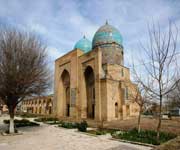
The Historic Centre of Shakhrisyabz, located on the Silk Roads in southern Uzbekistan, is over 2000 years old and was the cultural and political centre of the Kesh region in the 14th and 15th century. A collection of exceptional monuments and ancient quarters can be found within the medieval walls, parts of which still remain. The Historic Centre of Shakhrisabz bears witness to the city's secular development and to centuries of its history, and particularly to the period of its apogee, under the empire of Temur, in the 15th century. Construction of elements continued in Shakhrisyabz throughout different time periods, lending a unique character to the place by the succession of different architectural styles. Despite the inroads of time, the remaining vestiges are still impressive in the harmony and strength of styles, an enriching addition to the architectural heritage of Central Asia and the Islamic world.

Historic Centre of Shakhrisyabz Uzbekistan
Continent: Asia
Country: Uzbekistan
Category: Cultural
Criterion: (III)(IV)
Date of Inscription: 2000

Temurid Monuments

The Ak-Sarai Palace construction began in 1380, the year following Temur's conquest of Khorezm, whose artisans were deported to work on the palace and provide its rich decoration. Although Samarkand may boast a great many Temurid monuments, not one can rival the Ak-Sarai Palace in Shakhrisyabz. The foundations of its immense gate have been preserved: this architectural masterpiece is outstanding in its dimensions and bold design.

Historic Centre of Shakhrisyabz

Browse Gallery Plus UNESCO Storyline

The Dorus Saodat is a vast complex which was destined as a place of burial for the ruling family and contained, in addition to the tombs themselves, a prayer hall, a mosque, and accommodation for the religious community and pilgrims. The main façade was faced with white marble. The tomb of Temur, also of white marble, is a masterpiece of the architecture of this period and it is also one of the finest memorials to be found in Central Asia.

The covered Chor-su bazaar was built at the cross-roads of two main streets, in the form of an octagon with a central cupola, with no particular decoration but with an eye to the exterior effect of bold architecture. The baths, rebuilt on the site of the 15th century baths and still in use today, are heated by an elaborate network of underground conduits.

Shakhrisyabz contains not only outstanding monuments dating from the period of the Temurids, but also mosques, mausoleums, and entire quarters of ancient houses. In addition to these monuments, the town also offers a variety of interesting constructions of a more modern period, including the Mirhamid, Chubin, Kunduzar, and Kunchibar mosques. Period houses reflect a more popular architectural style, with rooms typically laid out around a courtyard with veranda.

Slideshow for this Heritage Site


Browse All UNESCO World Heritage Sites in . The original UNESCO inscription Here!!!

Historic Centre of Bukhara Uzbekistan

Bukhara, which is situated on the Silk Route, is some 25 centuries old. It is the most complete example of a medieval city in Central Asia, with an urban fabric that has remained largely intact. Monuments of particular interest include the famous tomb of Ismail Samani, a masterpiece of 10th-century Muslim architecture, and a large number of 17th-century madrasas. The historic part of the city, which is in effect an open-air museum, combines the city's long history in a single ensemble.

Historic Centre of Bukhara Uzbekistan
Continent: Asia
Country: Uzbekistan
Category: Cultural
Criterion: (II)(IV) (VI)
Date of Inscription: 1993

Cultural centre of the Caliphate of Baghdad

Archaeological excavations have revealed that the settlement on the site of latter-day Bukhara became part of the Kushan state as early as the 2nd millennium BC. In the 4th century it was incorporated into the Ephtalite state. Before the Arab conquest Bukhara was one of the largest cities of central Asia, owing its prosperity to its site on a rich oasis and at the crossroads of ancient trade routes. It became a major cultural centre of the Caliphate of Baghdad in 709, and in 892 the capital of the independent Samanid Kingdom. A time of great economic growth came to an end with the sack of the city in 1220 by the Mongol horde of Genghis Khan.

Historic Centre of Bukhara

Browse Gallery Plus UNESCO Storyline

It slowly recovered, to become part of the Timurid Empire. The internal strife of the late 15th century led to the occupation of Bukhara by nomadic Uzbek tribesmen led by Khan Sheibani, becoming the capital of the Bukhara Khanate. A long period of unrest and short-lived dynasties ended in 1920, when it was absorbed into the Soviet Union; nevertheless, this period saw Bukhara consolidating its role as a major commercial and cultural centre.

The townscape of latter-day Bukhara represents every stage of the city's history. The earliest monuments include the 10th century Ismail Samani Tomb, the decorated brick minaret of Poi-Kalyan from the 11th century, along with the Magoki Mosque and the Chasma Ayub Shrine. The Timurid period is represented only by the Ulugbek Medresseh. The most celebrated buildings date from the Shebibanid period - the Poi-Kalyan group, the Lyabi-Khauz ensemble, the Kosh Medresseh, and the Gaukushon Medresseh.

A little later came the medressehs at important crossroads, such as Taki Sarafon (Dome of the Moneyshangers, Taki-Tilpak-Furushan (Dome of the Headguard Sellers), Tim-Bazzazan, and Tim-Abdullah-Khan. Among the fine buildings erected in the anarchic early 17th century must be included the great new mosque Magoki Kurns

Slideshow for this Heritage Site


Browse All UNESCO World Heritage Sites in . The original UNESCO inscription Here!!!

Complex of Hue Monuments Vietnam

Complex of Hue Monuments represents an outstanding demonstration of the power of the vanished Vietnamese feudal empire at its apogee in the early 19th century. The complex of monuments is an outstanding example of an eastern feudal capital and of the planning and construction of a complete defended capital city in a relatively short period. The integrity of town layout and building design make it an exceptional specimen of late feudal urban planning. Hue served as the administrative centre of southern Vietnam in the 17th and 18th centuries. Gia Long, first ruler of the Nguyen dynasty, made it the national capital of united Vietnam in 1802, a position that it held until 1945.

Complex of Hue Monuments Vietnam
Continent: Asia
Country: Vietnam
Category: Cultural
Criterion: (IV)
Date of Inscription: 1993

Hue Monuments

Hue is situated in the geographical centre of the country and with easy access to the sea. The new capital was planned in accordance with ancient oriental philosophy in general and Vietnamese tradition in particular; it also respected the physical conditions of the site, especially the Perfume River and Ngu Binh Mountain (known as the Royal Screen)

The relationship between the five cardinal points (centre, west, east, north, south), five natural elements (earth, metal, wood, water, fire), and five basic colours (yellow, white, blue, black, red) underlies the conception of the city, and is reflected in the names of some important features. The Perfume River, the main axis, divides the capital in two.

Complex of Hue Monuments

Browse Gallery Plus UNESCO Storyline

Four citadels or defended enclosures made up the city: Kinh Thanh (Capital City), for official administrative buildings; Hoang Thanh (Imperial City) for royal palaces and shrines; Tu Cam Thanh (Forbidden Purple City) for the royal residences; Dai Noi (or Inner City); and Tran Binh Dai, an additional defensive work in the north-east corner of the Capital City, designed to control movement on the river. A fifth fortress, Tran Hai Thanh, was constructed a little later to protect the capital against assault from the sea.

Slideshow for this Heritage Site


Planning lasted from 1803 to 1805, and it was not until 1832 that construction was complete. The new capital was much larger than its predecessor, Dong Trang, and encompassed several villages as well. The fortress itself was modelled on the European style of Vauban, the first of its type in South-East Asia, but the complex suffered considerably as a result of military operations in 1885, 1947 and 1968.

The main enceinte, the Capital City, is square in plan, each side measuring 2,235 m. The defensive walls have six projecting bastions on each side and ten gates. The external defensive works comprise a berm, ditch, and glacis. The buildings inside the Capital City include various former ministerial buildings, the Royal College and the Hué Museum.

The Inner City is rectangular in plan and defended by brick walls, supplemented by a moat and wide berm; there is a single entrance on each of the walls. Inside it is divided by walls into a number of zones - the Great Ceremonies Zone, the Worshipping Zone, the residential zone of the King's Mother and Grandmother, the storage and workshop zone, the garden and school zone for royal princes, as well as the Forbidden Purple City. The palaces within the Inner City are similar in style and design, set on a raised podium, with wooden trusses (usually ironwood), gilded and painted pillars and rafters, brick walls, and roofs of yellow- or blue-glazed cylindrical tiles. Roof edges are straight, and the decoration, both internally and externally, is abundant. Among the most important buildings are the Palace of Supreme Harmony, the royal reception hall; the Mieu Temple, the royal place of worship; the Queen Mother's Palace; and the Pavilion of Dazzling Benevolence.

At the heart of the complex is the Forbidden Purple City, surrounded by brick walls. There is a single gate in the front wall, reserved for the use of the king, and the other walls have several entrances, each with a specific purpose. Originally there were over 40 buildings within the walls, but most are now in ruins and only their foundations survive.

Outside the Capital City there are several associated monuments of importance. These include the tombs of the Nguyen dynasty to the south of the Perfume River. Other structures along both banks of the river are buildings related to the spiritual life of the dynasty, including the Temple of Literature, the Esplanade of the Sacrifice to the Sun and Earth, the Royal Arena and the Temple of the Roaring Elephant, and the Celestial Lady Pagoda.

Browse All UNESCO World Heritage Sites in . The original UNESCO inscription Here!!!