Pages

Showing posts with label Indonesia. Show all posts

Cultural Landscape of Bali Province

The cultural landscape of Bali consists of five rice terraces and their water temples that cover 19,500 ha. The temples are the focus of a cooperative water management system of canals and weirs, known as subak that dates back to the 9th century. Included in the landscape is the 18th-century Royal Water Temple of Pura Taman Ayun, the largest and most impressive architectural edifice of its type on the island. The subak reflects the philosophical concept of Tri Hita Karana, which brings together the realms of the spirit, the human world and nature. This philosophy was born of the cultural exchange between Bali and India over the past 2,000 years and has shaped the landscape of Bali. The subak system of democratic and egalitarian farming practices has enabled the Balinese to become the most prolific rice growers in the archipelago despite the challenge of supporting a dense population.

Cultural Landscape of Bali
Continent: Asia
Country: Indonesia
Category: Cultural
Criterion: (II)(III) (V) (VI)
Date of Inscription: 2012

The landscape of Bali

A line of volcanoes dominate the landscape of Bali and have provided it with fertile soil which, combined with a wet tropical climate, make it an ideal place for crop cultivation. Water from the rivers has been channelled into canals to irrigate the land, allowing the cultivation of rice on both flat land and mountain terraces.

Rice, the water that sustains it, and subak , the cooperative social system that controls the water, have together shaped the landscape over the past thousand years and are an integral part of religious life. Rice is seen as the gift of god, and the subak system is part of temple culture. Water from springs and canals flows through the temples and out onto the rice paddy fields. Water temples are the focus of a cooperative management of water resource by a group of subaks . Since the 11th century the water temple networks have managed the ecology of rice terraces at the scale of whole watersheds. They provide a unique response to the challenge of supporting a dense population on a rugged volcanic island.

Cultural Landscape of Bali Province

Browse Gallery Plus UNESCO Storyline

The overall subak system

The overall subak system exemplifies the Balinese philosophical principle of T ri Hita Karana that draws together the realms of the spirit, the human world and nature. Water temple rituals promote a harmonious relationship between people and their environment through the active engagement of people with ritual concepts that emphasise dependence on the life-sustaining forces of the natural world.

In total Bali has about 1,200 water collectives and between 50 and 400 farmers manage the water supply from one source of water. The property consists of five sites that exemplify the interconnected natural, religious, and cultural components of the traditional su b ak system, where the subak system is still fully functioning, where farmers still grow traditional Balinese rice without the aid of fertilisers or pesticides, and where the landscapes overall are seen to have sacred connotations.

Slideshow for this Heritage Site


The sites are the Supreme Water Temple of Pura Ulun Danu Batur on the edge of Lake Batur whose crater lake is regarded as the ultimate origin of every spring and river, the Subak Landscape of the Pakerisan Watershed the oldest known irrigation system in Bali, the Subak Landscape of Catur Angga Batukaru with terraces mentioned in a 10th century inscription making them amongst the oldest in Bali and prime examples of Classical Balinese temple architecture, and the Royal Water temple of Pura Taman Ayun, the largest and most architecturally distinguished regional water temple, exemplifying the fullest expansion of the subak system under the largest Balinese kingdom of the 19th century.

Subak components are the forests that protect the water supply, terraced paddy landscape, rice fields connected by a system of canals, tunnels and weirs, villages, and temples of varying size and importance that mark either the source of water or its passage through the temple on its way downhill to irrigate subak land.

Browse All UNESCO World Heritage Sites in . The original UNESCO inscription Here!!!

Tropical Rainforest Heritage of Sumatra Indonesia

Tropical Rainforest Heritage of Sumatra Indonesia, the 2.5 million hectare Tropical Rainforest Heritage of Sumatra site comprises three national parks: Gunung Leuser National Park, Kerinci Seblat National Park and Bukit Barisan Selatan National Park. The site holds the greatest potential for long-term conservation of the distinctive and diverse biota of Sumatra, including many endangered species. The protected area is home to an estimated 10,000 plant species, including 17 endemic genera; more than 200 mammal species; and some 580 bird species of which 465 are resident and 21 are endemic. Of the mammal species, 22 are Asian, not found elsewhere in the archipelago and 15 are confined to the Indonesian region, including the endemic Sumatran orang-utan. The site also provides biogeographic evidence of the evolution of the island.

Tropical Rainforest Heritage of Sumatra Indonesia
Continent: Asia
Country: Indonesia
Category: Danger
Criterion: (VII)(IX) (X)
Date of Inscription: 2004

Andes of Sumatra

The parks that comprise the Tropical Rainforest Heritage of Sumatra are all located on the prominent main spine of the Bukit Barisan Mountains, known as the 'Andes of Sumatra'. Outstanding scenic landscapes abound at all scales. The mountains of each site present prominent mountainous backdrops to the settled and developed lowlands of Sumatra. The combination of the spectacularly beautiful Lake Gunung Tujuh (the highest lake in southeast Asia), the magnificence of the giant Mount Kerinci volcano, numerous small volcanic, coastal and glacial lakes in natural forested settings, fumaroles belching smoke from forested mountains and numerous waterfalls and cave systems in lush rainforest settings, emphazise the outstanding beauty of the Tropical Rainforest Heritage of Sumatra.

Tropical Rainforest Heritage of Sumatra
Baby Tigers: Tropical Rainforest of Sumatra

Browse Gallery Plus UNESCO Storyline

The Tropical Rainforest Heritage

The Tropical Rainforest Heritage of Sumatra represent the most important blocks of forest on the island of Sumatra for the conservation of the biodiversity of both lowland and mountain forests. This once vast island of tropical rainforest, in the space of only 50 years, has been reduced to isolated remnants including those centred on the three nominated sites. The Leuser Ecosystem, including the Gunung Leuser National Park, is by far the largest and most significant forest remnant remaining in Sumatra. All three parks would undoubtedly have been important climatic refugia for species over evolutionary time and have now become critically important refugia for future evolutionary processes.

All three parks that comprise the Tropical Rainforest Heritage of Sumatra are areas of very diverse habitat and exceptional biodiversity. Collectively, the three sites include more than 50% of the total plant diversity of Sumatra. At least 92 local endemic species have been identified in Gunung Leuser National Park. The nomination contains populations of both the world's largest flower (Rafflesia arnoldi) and the tallest flower (Amorphophallus titanium). The relict lowland forests in the nominated sites are very important for conservation of the plant and animal biodiversity of the rapidly disappearing lowland forests of South East Asia. Similarly, the montane forests, although less threatened, are very important for conservation of the distinctive montane vegetation of the property.

Slideshow for this Heritage Site


Browse All UNESCO World Heritage Sites in . The original UNESCO inscription Here!!!

Borobudur Temple Compounds Indonesia

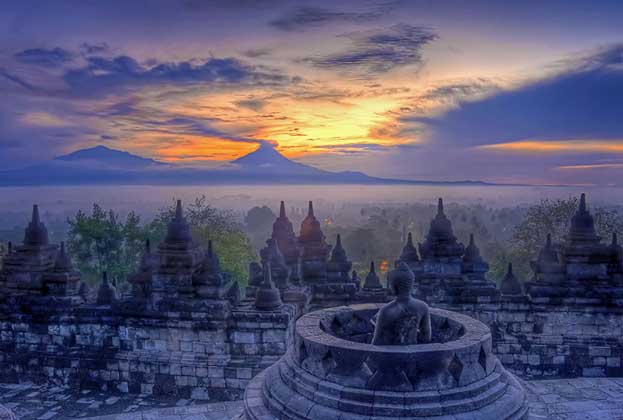
Borobudur Temple Compounds: This famous Buddhist temple, dating from the 8th and 9th centuries, is located in central Java. It was built in three tiers: a pyramidal base with five concentric square terraces, the trunk of a cone with three circular platforms and, at the top, a monumental stupa. The walls and balustrades are decorated with fine low reliefs, covering a total surface area of 2,500 m2. Around the circular platforms are 72 openwork stupas, each containing a statue of the Buddha. The monument was restored with UNESCO's help in the 1970s. Borobudur is one of the greatest Buddhist monuments in the world. Founded by a king of the Saliendra dynasty, it was built to honour the glory of both the Buddha and its founder, a true king Bodhisattva. The name Borobudur is believed to have been derived from the Sanskrit words vihara Buddha uhr, meaning the Buddhist monastery on the hill. Borobudur temple is located in Muntilan, Magelang, and is about 42 km from Yogyakarta city.

Borobudur Temple Compounds Indonesia
Continent: Asia
Country: Indonesia
Category: Cultural
Criterion: (I) (II) (VI)
Date of Inscription: 1991

Divine monuments

This colossal temple was built between AD 750 and 842: 300 years before Cambodia's Angkor Wat, 400 years before work had begun on the great European cathedrals. Little is known about its early history except that a huge army of workers worked in the tropical heat to shift and carve the 60,000 m3 of stone. At the beginning of the 11th century AD, because of the political situation in Central Java, divine monuments in that area, including the Borobudur Temple became completely neglected and given over to decay. The Sanctuary was exposed to volcanic eruption and other ravages of nature. The temple was not rediscovered until the 19th century. A first restoration campaign, supervised by Theodor van Erp, was undertaken shortly after the turn of the century. A second one was led more recently (1973-82).

Borobudur Temple Compounds Indonesia Heritage
Borobudur Temple Compounds Indonesia

Browse Gallery Plus UNESCO Storyline

five square terraces

A harmonious marriage of stupas, temple-mountain and the ritual diagram, this temple complex was built on several levels around a hill which forms a natural centre. The first level above the base comprises five square terraces, graduated in size and forming the base of a pyramid. Above this level are three concentric circular platforms crowned by the main stupa. Stairways provide access to this monumental stupa. The base and the balustrades enclosing the square terraces are decorated in reliefs sculpted in the stone. They illustrate the different phases of the soul's progression towards redemption and episodes from the life of Buddha. The circular terraces are decorated with no fewer than 72 openwork stupas each containing a statue of Buddha.

Slideshow for this Heritage Site


Browse All UNESCO World Heritage Sites in . The original UNESCO inscription Here!!!

Tanah lot bali beach

Tanah lot bali beach - World Tourism times this will provide a review  Tanah Lot of attractions on the island of Bali. Bali is the most famous attractions of Indonesia country. Tanah lot bali beach One of them is located in the village of Tabanan District Beraban Kediri or rather 13km west of Tabanan. Here there is a temple called Pura Uluwatu is located on a large stone standing on the beach cliffs. It was said Pura Tanah lot bali beach, Bali is part of the heaven and Dang temple replica temple of the god of the sea, including marine guards in the area of ​​Bali.
Tanah lot bali beach
In the area around Tanah lot bali beach handicraft arts, there are some results of the local community. The inn also has ample parking and clean. In Tanah lot bali beach you can enjoy the beautiful sunset at around 17:00 to 18:00 AM. This can be more beautiful scenery to be enjoyed when you are standing on a cliff while enjoying food restaurants.
Tanah lot bali beach
The following is a schedule of ceremonies at Tanah lot bali beach:
-On the 16th of June to celebrate Saraswati holiday. Saraswati is the goddess of knowledge in Bali. This ceremony is celebrated with less to clean the castle castle around Tanah lot bali beach also decorate it.
-In June 4th is celebrated Purnama Sadha or commonly called the Full Moon in Bali. This month is considered good, so are hundreds of temples celebrate
-On June 5 Anggara Kasih Dukut known, or commonly known as Anggara Kliwon which is a good day for physical cleaning of each individual family. Usually they meditate and pray to god Ludra.
-On June 10, is a good day for them to clear the mind and the environment from negative home compound. They used to meditate and pray to Lord Shiva.
Tanah lot bali beach
If you have plans to vacation in Bali island, then do not miss a chance at Tanah lot bali beach. Because a lot of interesting things here that I can not mention one by one.
Tanah lot bali beach

Sri Gethuk Waterfall, Grand Canyon of Yogyakarta


Exotic Grand Canyon in northern Arizona, the United States would no longer be denied. Grand Canyon is a natural formation of ravines and steep cliffs are decorated by the flow of the Colorado River. Name of the Grand Canyon and then spoofed into Green Canyon to name a tourist attraction in West Java are quite similar, the flow of the river that divides the high cliffs. Gunungkidul as an area that is often assumed to be dry and barren region was also similar to the beauty store, the green of the river which divides the canyon with a beautiful waterfall that never stops flowing in every season. The waterfall is known as Sri Gethuk Waterfall.


Based on a story that people believe, the waterfall is a storage place kethuk which is one of Jin's gamelan instruments Anggo Meduro. Therefore, it is called by the name of Sri Gethuk Waterfall. That said, at certain times of the Hamlet Menggoran gamelan is often heard coming from the direction of the waterfall. 
 
This waterfall can be reached for approximately two hours from the city of Yogyakarta. Initially, I thought that the way to the sights completely smooth. Apparently when entering the village Bleberan, poor road infrastructure and a bit rocky. However, all of it paid by the beauty of Sri Gethuk Waterfall.

Tana Toraja

Tana Toraja is a district that is 300 km from the city of Makassar, Indonesia. This place has a very impressive natural scenery of granite stone, green rice fields and patches of mountain and burial complexes that can make chilling shudder. Now Tana Toraja is one of the tourist attraction in Indonesia, is inhabited by the Toraja tribe who live in mountainous areas and maintain a typical lifestyle and still show the original Austronesian lifestyle. But nowhere is this more exciting if we can travel here primarily to coincide funeral commonly called 'signs Tuka'.


In Toraja society, the funeral rites of the most important and expensive. People who are more wealthy and powerful, funeral expenses will be more expensive. The body of the deceased are not buried but in a place (traditional house) tongkonan, and also held cutting diacara buffalo. In addition, we can visit the various types of funeral here as in baby death 'Kambira' in the tree, the bodies 'Stone tumonga' on the rocks and in caves Rantepao. Funeral was held only occasionally after weeks, months, even years since the death in question, with the goal of keeping the family left behind to collect enough money to cover funeral expenses. Toraja tribe believes that death is not something that comes with a sudden but a gradual process toward Puya (the spirit world, or the afterlife). In the waiting period, the corpse is wrapped with several pieces of cloth and kept under these tongkonan.

So if you want to feel the area is still exotic, has a wealth of cultural and remote, would not hurt you to try to come to this place and feel the different atmosphere. Foreign and local tourists and many say that this place is one vacation destination or travel frightening and extreme.


Fatahillah Museum / Museum of History of Jakarta / Batavia Museum

Fatahillah Museum / Museum of History of Jakarta / Batavia Museum is a museum of more than 1,300 square meters which is very historic and famous in his country. The museum is located at Jalan Taman Fatahillah No.. 2, Jakarta, Indonesia this was once a City Hall that was built in 1707-1710, then on March 30, 1974 was inaugurated as a museum Fatahillah.


Museum which contains the history of the city of Jakarta and Jakarta associated with this built in the style of the 17th century classic, with three floors and paint a yellow ground, door frames and windows of teak dark green.


Maimun Palace

Maimun Palace is one of the famous tourist attractions in the country. This place is a palace with an area of ​​approximately 2772 m², and has 30 rooms. This palace has a beautiful and unique design, the mixing of the elements of the cultural heritage of Malay, Islam, Spain, India, and Italian styles.
The palace was built in 1887-1891 is located in Medan Maimun district, the city of Medan, North Sumatra, Indonesia.


Mendut Temple

Mendut Temple is one of the most famous Buddhist temples in the world besides the temple of Borobudur, especially for Buddhists. Mendut is the oldest of three Pawon and Borobudur temple. And restoration of this temple began in 1897 and completed in 1925.

Mendut a ninth century temple is located three kilometers east of Borobudur, precisely located in the village of Mendut, Mungkid district, Magelang regency, Indonesia.
At the time of full moon in May or June, Buddhists undergo Vesak annual ritual walk from Mendut Pawon past and ended through the Borobudur.

National Monument

National Monument or called Monas is a very famous monument in Indonesia. Everyone in that State will be very aware about the monument on this one. It lies right in the middle of Merdeka Square, Jakarta. Monas becomes very important because it is a most important monument. Monument as high as 132 meters (433 feet) was built to commemorate the resistance and the Indonesian people's struggle to win independence from the colonial Dutch East Indies.

Construction of this monument began on August 17, 1961 under the orders of President Sukarno, and was opened to the public on July 12, 1975. Additionally Monas became famous for his top tip of the monument is crowned with flames form a coated sheet of gold which symbolizes the spirit of struggle burning. And now the monument became one tourist destination in Indonesia, both local and foreign tourists.


Lake Toba

Lake Toba is a volcanic lake that became one of the most calm and quiet that can be visited by people. Lake with a length of 100 kilometers and 30 kilometers wide is located in North Sumatra Province, Indonesia. And is the largest lake in Indonesia and Southeast Asia. In the middle of this lake there is a volcanic island called Samosir Island.

Lake Toba explosion occurred because about 73000-75000 years ago and an eruption (super volcano) the most recent.
Volcanic dust in the wind has spread to half the earth, from China to South Africa. The explosion occurred during a week and throw the dust up to 10 km above sea level.

But now Lake Toba was not terrible anymore, because now the lake has become one of the most interesting sights, especially in North Sumatra Indonesia, thus attracting local and foreign tourists.

Timbulun Falls

Timbulun Falls is a tourist place not many tourists inside and outside the country know about it. But the actual ar falls very much at all to have a hidden beauty. Location of the waterfall is located in the village of East Painan, District IV Jurai, South Coastal District, Indonesia. The beauty of this waterfall is that it consists of several levels which have the form of waterfalls and different depths. This Timbulun upstream waterfall in the area of ​​Kerinci Seblat National Park and empties into the ocean or the bay Painan Indonesia.


At the first level waterfall, the waterfall is the first time we met so we arrive at the location Timbulun, here there is a rather large depths is and is good for bathing and swimming. At the second level waterfall, waterfall is somewhat sloped, the water fall where there is the beautiful depths of the cliff and base themselves is composed of rocks formed by nature. And the second level is the most commonly used for bathing and swimming, because the most beautiful scenery.
And on the third level, is an upright vertical waterfall about 15 meters, also has deep deep, and here slightly greenish water.


Raja Ampat Islands

Raja Ampat Islands is one of the resorts are very potential to be a place tourism, especially diving tourism. Raja Ampat Islands located on the westernmost tip of New Guinea, about 50 miles northwest of Sorong, Indonesia.

According to some sources, the waters of Raja Ampat Islands is one of the 10 best waters for diving sites around the world. In fact, it may also be recognized as number one for the completeness of underwater flora and fauna at this point, even making the 75% of the world's coral species in Raja Ampat.
Approximately 450 species of coral had been identified during the two weeks of research in the area. Even a study ever undertaken here and recorded in these waters there are more than 540 hard coral species (75% of the total species in the world), more than 1,000 species of reef fish, 700 species of molluscs, and the highest record for gonodactyloid stomatopod crustaceans. And unique species that can be found at the diving is some kind of pigmy seahorse or kudalaut mini, wobbegong and manta ray. There are also endemic fish Raja Ampat, namely Eviota king, which is a kind of fish gobbie.


Galang Island

Galang Island is an island that has an area of ​​approximately 80 km2, located 350 m (560 miles) southeast of Batam, Indonesia. Galang included in a series of three large islands connected by six bridges Barelang (abbreviation of Batam, Galang Rempang-).

The island is famous because of the Vietnamese refugee camps that occurred on a large scale in the year 1979 - 1996 and to the attention of the UN and the international parties. And at that moment there was a major administrative UNHCR office to run the Galang Refugee Camp, where many Vietnamese boat people and asylum seekers who temporarily accommodated during the determination of refugee status and their subsequent settlement in the United States, Australia and some European countries.

Now this Galang refugee camps become tourist attraction and historical city of Batam, because it is relatively close to the island of Batam (about 7 miles). In addition to this attraction, Galang island is also visited by many tourists on weekends because of Melur in the western coast of the island is quite beautiful.